Sunday, May 13, 2012

Comic Irrelevancies--1


They Don't Do This Anymore...

Browsing the fabulous Digital Comics Museum archive, I came across this on the inside front cover of an early-1941 issue of Whiz. The reproduction comes from microfiche, but it's still readable.

Two things strike one. First, that the comic lists complete home addresses of the would-be traders. Secondly, there are some pretty wild items for trade. Notable are several guns (shotgun, .22 rifle), a hunting knife, and a 16mm projector (its owner wants to trade it for a printing press). It's like the pre-war ebay.

I hate it when old fogies like me carry on about how things used to be different harrumph blah blah. But there's no denying some things have changed. No publisher would dream of printing kids' home addresses these days. Back in the late 60s Marvel did so in all their letter columns, apparently without major problems. I had a couple of letters printed, and never received sleazy advertisements or letters from pervs. On the contrary, I received a copy of Jerry Bails' legendary Guidebook to Comic Fandom, through which I was introduced to the world of fanzines and comics collecting.

Wait a minute! I was sent a gateway drug leading to fan addiction! Guess things weren't so safe even back then.

Friday, April 27, 2012

Bob Oksner--Comic Artist


Bob 'n' Boone

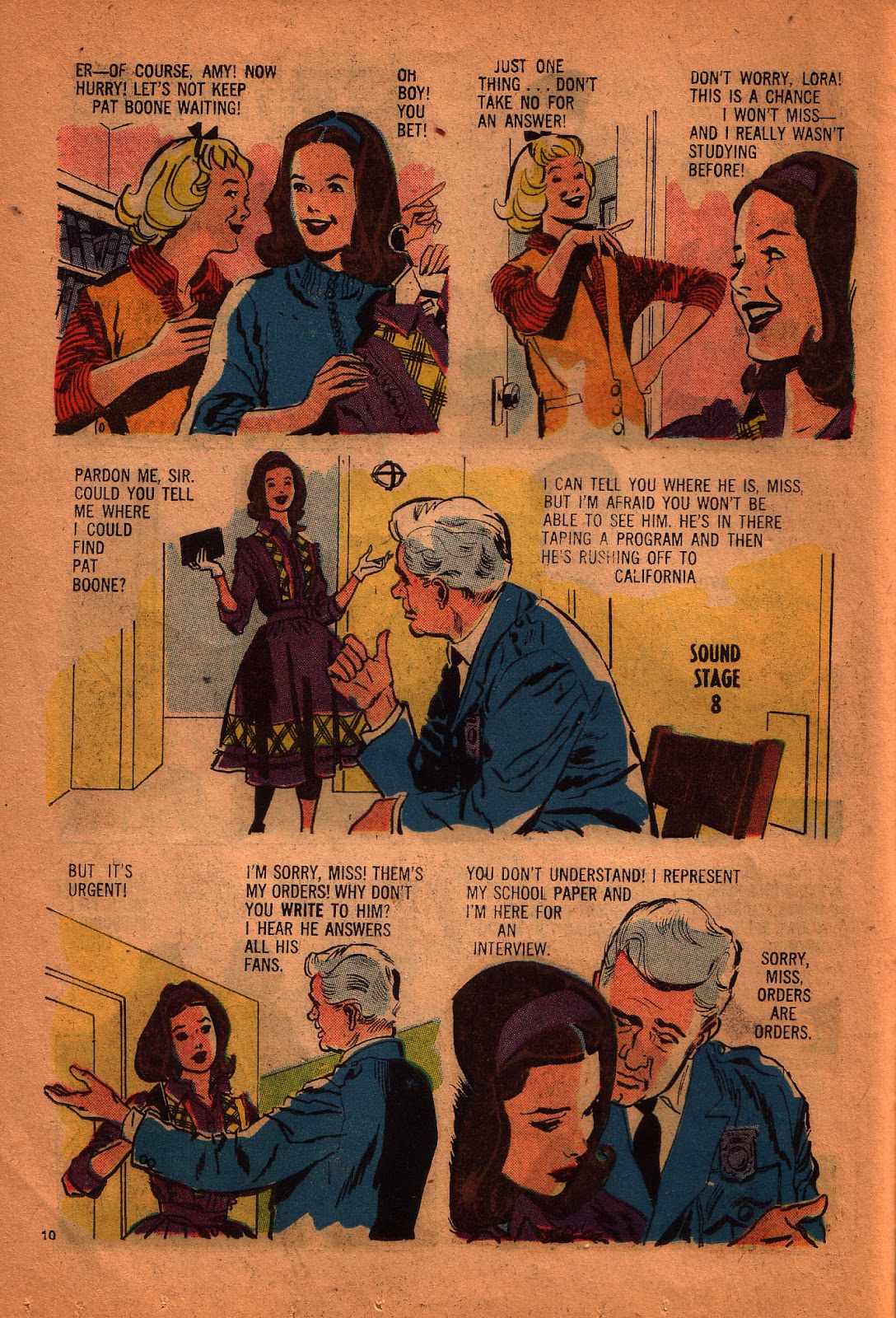
I have only one (issue #2) of the five issues of Pat Boone, an oddball DC comic from 1959. Today when people think of 1950s pop music they think of Elvis and the early rock 'n' rollers. At the time, though, this squeaky-clean descendant of old-time crooners out-polled and outsold them all. This comic was part of DC's attempts to cash in on Pat's popularity. He also did guest shots in DC's regular titles, like Superman.

Though Pat Boone is in comic book format, it's more like a fan magazine. Numerous text features offer teen advice, record reviews, and celebrity bios. There are two comic stories, but even these go out of their way not to look like comic stories. There are no panel borders or balloons. Typeset dialogue floats in space with an occasional pointer if the speaker isn't obvious from the artwork.

The only reason to pay any attention to Pat Boone is Bob Oksner's superb artwork on the comic features. One concerns Pat's family life and co-stars lots of little kids. The other features Pat's fan base, teenage girls. Oksner draws in a more illustrator-y style than usual. Obviously he's working from photos, but there's so much spirit and skill in his drawings that the photo basis isn't overpowering.

Both stories are pleasing to the eye, but the lead story, the teenager one, takes the prize. The figures are full of life, with great posing and beautiful expressions. And the girls actually look like girls rather than the twenty-somethings who passed for teenagers in romance comics of the period.


Here's the story.


Monday, April 16, 2012

Thomas Kinkade, Painter

Some Kind of a Man


Paul Chadwick, Tom Kinkade, and Jim Gurney in a Polaroid
reference shot for a forgotten illustration.

In the days since the death of painter Thomas Kinkade I've been irked by the online outpourings of both his admirers and his detractors. The former gush syrupy paeans about Christian devotion and speaking great truths. The latter rupture themselves straining for the nastiest ways to express contempt for Kinkade and his fans. Missing is any attempt to see him as a human being.

Commentators mention specific events in Kinkade's life only as evidence supporting their opinions. Admirers dwell on his noble early struggles, his charity work, and his long marriage. Detractors prefer his shady business dealings and his drunken excesses. To both camps Thomas Kinkade is a mythical construct representing their interpretations of his art and career. Was the Painter of Light a paragon of traditional values and American entrepreneurism? Or was he a purveyor of schlock who preyed upon the booboisie? Neither, really. And both.

Those of us who knew Tom back before he got his "h," back in the crazy days of the art colony at the crumbling Golden Palm apartments, have been mulling over the arc of his life. How did the guy we knew become the millionaire commander of a beseiged outpost at the edge of the Culture Wars?

I was Tom's neighbor for several years while he was finishing his time at Art Center and working to establish a gallery presence. I was some ten years older than most of the "GP" gang. Tom Kinkade, Jim Gurney, Paul Chadwick, Alan Munro and the others were just leaving school when I arrived in LA. Despite my age I was at much the same stage in my career. Ever a late bloomer, I'd come to LA in hopes of finally finding a place in comics.

Because I never roomed with Tom or attended school with him, I didn't know him as well as Paul Chadwick. This memoir from Paul's blog offers a good account of the challenges of living with young Tom Kinkade. Since I didn't have to deal with as much BS as Paul, I ended up liking Tom more that he did. Still there was no denying that Tom was quite a handful.

The major theme of Tom's GP years was self-invention. He seemed obsessed with wanting to live like an Artist. He tried to dress an an Artist would dress, think as an Artist would think, do what an Artist would do. Determining exactly what that was became the focus of his existence.

Paul describes the manic energy with which Tom careened from one grandiose idea to another. Societies, styles, movements, enterprises...he'd dream them up and dissolve them in a single breath. But unlike many budding Artistes Tom wasn't all talk. He constantly dared himself to do the grand and crazy things that Artists would do, as if he had to prove to himself that he was indeed the Real McCoy.

His comrade-in-arms in this quest for the mythic life was his friend Jim Gurney. They fed off each other's energy, playing pranks, acting like loons, goading each other into wild stunts. They dressed in identical work uniforms (complete with embroidered name badges) and addressed each other as "Jackson." They played a non-stop vaudeville act, baffling us rubes with loud patter and dazzling us with the risks they'd take for art. One time they visited the seamy side of town and performed their floor show while sketching gang members. Another time they wore their matching work shirts to a notorious biker bar, sat down and began drawing the patrons without asking their permission.
Reference Polaroid of Ron taken by Paul
for a movie poster comp
Being terminally shy and a thorough coward, I often envied the exploits of "The Incredible Two-Headed Jackson Monster." But to tell the truth most of the time they could be a major pain in the ass. Stunt diving into the pool could be funny. Pouring a shellac "J" on my doorstep and setting it afire, not so much. The act broke up when the Jacksons married and found their wives weren't as fond of the team as the guys were.

I got to know Tom as well as I ever did while I was drawing "Dallas" and "Star Trek" for the Los Angeles Times Syndicate. I usually worked all night and slept during the day. Tom was on the same schedule, preparing for one of his first big shows. The Western Art Boom of the early 1980s was in full swing. Inspired by the work of Michael Coleman, Tom was painting romantic landscapes with a teepee or two added to lend a Western flavor. Back then he worked sitting before his easel, surrounded by a wilderness of sketches, photos, prints and clippings.

Tom was on some kind of impossible deadline--he'd committed to painting dozens of canvases in just a few weeks. This is where I saw a side of him that people seldom mention. He worked his ass off. True, he quickly developed a formula to speed the process along. But I assure you that Tom didn't just amble into gallery painting, he got there via the Long March.

Anyway, we'd both run out of steam around two A.M. For a break we'd stroll up the street to an all-night cafe. We'd talk art and watch drunks wander in as the bars emptied. Sometimes Tom would engage one in conversation, always with a kind of smirking superiority that made me uncomfortable. We frequently discussed the business of art. Tom had determined that the key to success was a winning formula and a huge output. He thought he might be able to get a whopping $300 per canvas, and if he sold enough of them--that's where the story always ended. Back then, at least, Tom wasn't envisioning an empire.

In those chats we covered a lot of ground: Victorian painters, color theory, comics, money, women. But I never got much of a sense of the "real" Tom. When he spoke of his past or his longing for his sweetheart Nanette, it always came out sounding like a story. It's as if Tom knew himself only through the same romanticized fables he told the rest of us.

After Tom married he and Nanette moved to Placerville, his old home town. He'd had some success and made a lot of contacts, but he was still a struggling artist. In Placerville he painted his first John Stobart-inspired city print. This was the famous print he and Nanette hawked in front of a grocery store. It was his first solid step up the ladder to fame. It was a nice painting. Tom gave Jan and me a print in 1985, when our son Joey was still a work in progress. He inscribed it to "Ron, Jan and Jr." The print hangs over our piano.

We visited Tom and Nanette at their Placerville home. Tom had built an enviable studio in the old barn next door. To Jan's annoyance (and I imagine Nanette's) Tom ignored the women so he could talk art with me. By this time he was full of plans--still no empire--and was confident of a great future.

We enjoyed one more visit with Tom and Nanette. Their first daughter was a just a baby. We spent a couple of days in a cabin in the magnificient Kings Canyon national forest. We had a great time. We talked (all of us this time), admired the kids, played with a friendly dog. Tom painted a skillful landscape while I struggled with starting one (I never learned how to paint outdoors). Tom offered advice and did a welcome paintover.

Years passed before we met Tom again. By that time he was a star. He invited us to a big bash in Monterey honoring his birthday. The show was fun in its way, but it was unmistakably planned by Tom to celebrate the Legend of Tom. He'd flown in a teacher he'd admired so the elderly man could say hagiographic things about him. He told larger-than-life stories about the GP days. He drank too much and became sentimental and noisy. After that party, he rose into the ranks of the super-rich and we never saw him again.

In an article in the late Thomas Kinkade's home town newspaper, people described major changes in Tom's life during the two years before his death. Nanette, now estranged after decades of marriage, said they'd split because Tom felt the need to "live the artist's life." Neighbors described him changing how he dressed, growing new facial hair, acting "differently." Could it really be that banal? After all the millions of dollars, the fame, the years of marriage, the sharky business, the drinking, after building the empire and watching it crumble--after all that, was Tom still trying on new costumes, still looking for an identity that fit him?

Which brings us back full circle to the lovers and the haters. What is it about humans that drives us to condense a person's life into a two-line caption that ties everything neatly together and explains all the inconsistencies? We build ridiculous straw men, selecting and rejecting aspects of complex lives in such a way that our final assembly makes a sort of sense. We confuse the man's paintings with the man himself. We pretend our myth man deliberately sent his works into the world to create the results we admire or revile. If we like the paintings, Tom was a saint who painted them to spread joy to the world. If we don't, Tom was a predatory swine who painted them to exploit the common man's gullibility.

Weren't Tom's paintings like every thing else in his life--reflections of the contradictory dreams and desires and fantasies inside his complicated head? Could Tom be friendly, generous, creative, even loving? Probably. Could Tom also be grasping, self-delusional, crass, even heartless? Probably. Contrary to the old saying, you can have it both ways. You must have it both ways.

Oddly enough I'm reminded of a movie. In Orson Welles' 1958 drama "Touch of Evil," policeman Hank Quinlan (Welles) destroys himself with evil deeds done in the name of good. At the end of the movie someone asks his long-suffering mistress Tanya  (Marlene Dietrich) what the man was like.

"He was some kind of a man," she replies.

Many critics took her statement to be the old American idiom expressing admiration. They wondered how Tanya, who knew Quinlan's depredations better than anyone, could admire him. Other writers--I believe they were the ones who caught Welles' real meaning--heard it differently.

"He was some kind of a man." She really didn't know. Hank Quinlan was the sum of all the things, good and bad, that he did in his life, and the sum made no sense. All he was--was something.

That's where I end up with Tom. Thomas. Thom. I want as much as anyone to force his life to make sense, but having known and liked him I can't take the easy way out by turning him into a symbol. What remains is that Tom was some kind of a man, and that's all I'll ever know.

Thursday, April 12, 2012

Willy Pogany Retrospective

Willy Pogany, 1882-1955

 A Longer Look at Willy Pogany
After my last post a friend wrote to say he'd been familiar only with Willy Pogany's Art-Nouveau-inspired illustrations for Padraic Colum's books. It was a great excuse to share just a few of the works of this prolific and remarkably versatile illustrator.

Willy Pogany was born in Hungary in 1882. After studying art in Paris he moved to London where, beginning in the early 1910s, he built a solid reputation as a book illustrator. He married and moved with his wife to America. He was naturalized as an American citizen in 1921. Here's a link to Pogany's Wikipedia biography, which includes several useful links if you want to learn more about him. It also tells how to pronounce his name.
Cosmetic Ad, 1923

From his "Watercolor Lessons;" probably from an earlier illustration
Most of the pictures I'll show here I found scattered about the Net. Googling Pogany images is a great adventure--the longer you look the more incredible stuff you find!
Red Cross Magazine June 1919
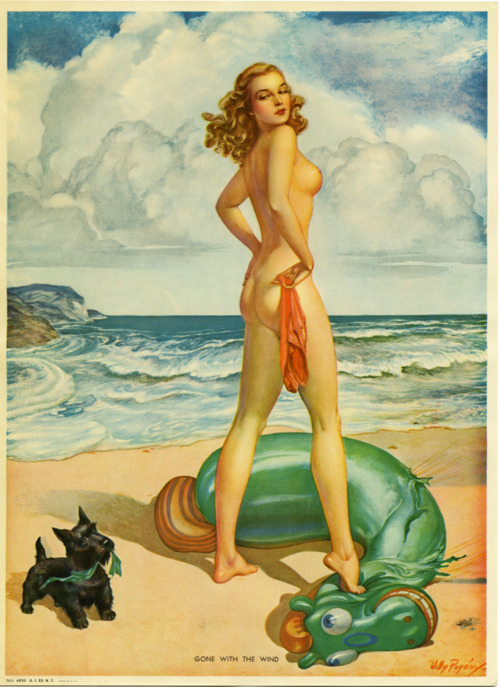
Pogany's two outstanding characteristics were his versatility and his amazing stylistic range. He illustrated books, art-directed major Hollywood films, sculpted, did magazine covers, designed private rooms and stage sets, painted murals, taught, and wrote books. It seemed as if every art project he undertook, he produced in a style unlike all the others. This is why it's so much fun to hunt for his images. You'll find realistic and stylized, cartoony and grandiose, elevated and lowdown, in every medium. What I show here is the tip of the iceberg. Stick around after the show for a special treat: a personal appearance by The Man himself.
From one of his versions of the Rubaiyat of Omar Khayyam (he did at least two)

 "Amethyst" from a birthstone series for American Weekly

 Mother Goose--a remarkable design/illustration project

 Tannhauser

 "The Wishing Ring Man," 1917


"Sapphire," another birthstone from The American Weekly (1945)


Faust

American Weekly, 9 Mar 1947, featuring Snow White and Rose Red
From Ladies' Home Journal

One of several terrific covers for Metropolitan Magazine--circa 1916

Another great Metropolitan cover, Aug 1916

Willy shows his naughty side. Source unknown

The Taming of the Shrew

From his "Drawing Lessons" book--these were studies for one of his Omar Khayyam books

Spectacular sirens...kind of sloughed off Odysseus and the boat, though (who's looking?)
 Nasty Willy! As far as I know "The Songs of Bilitis" was his only erotic art...here he carried the concept of "phallic symbol" to almost laughable extremes (probably on purpose).


And now the treat I promised you. Follow this link to a 1933 newsreel featurette called "The Stars of Tomorrow," in which Willy Pogany and Johnny Mack Brown ham it up while Willy pretends to draw one of the girls' portrait.

Tuesday, March 13, 2012

Willy Pogany, Illustrator

Meet the New Bossie, Same as the Old Bossie
Willy Pogany (1882-1955) was a Hungarian-born illustrator who produced a vast, diverse body of work in England and the United States. Working in a wide variety of styles, he illustrated books, art directed movies, painted murals for public and private buildings, wrote art instruction books, and who knows what-all. Prolific was the guy's middle name. For some extra details, see his Wikipedia entry.

Pogany was an excellent draughtsman, though he often put that aside to create extravagant drawings in the Art Nouveau and Art Deco styles.

Out of the Infinitely Surprising Scrap File I extracted this clipping from a 1934 Fortune magazine. It's a concept painting (as we call them these days) for the Technicolor finale of Kid Millions, a comedy-musical starring Eddie Cantor. The number takes place in a wild fantasy ice cream factory where scores of lovely Goldwyn Girls serve ice cream to a sea of brats. This kid-book-style watercolor showcases one of a thousand Pogany art styles.

Friday, March 2, 2012

1050s Gouache Technique

Heads Up!
Wandering through the scrap file I came upon these three heads clipped from some mid-1950s magazines. I post them as beautiful examples of the gouache painting style of the period. The dad and son were a story illustration for some women's mag while the nautical smoker starred in a Lucky Strike ad--probably from a male-oriented magazine like True. Artists unknown.


Sunday, February 19, 2012

John Held, Jr.--Novelist


Thar's Gold in Them Thar Digs!

Back in my paperback-collecting days I amassed quite a few Dell Mapbacks. When I sold the collection I kept several intending someday to read them. One was Crosstown, a 1933 novel by John Held, Jr. I was curious to see how the legendary cartoonist would treat "the story of a Jazz Age gold-digger." 

Some fifteen years later "someday" arrived. I spent several hours in the tub following the career of Mary "Mazie" Petropolis as she rises from tenement slum child to Broadway star. For those of you sensitive to "spoiler alerts," stop now. I will be telling the whole story. Most of you will be grateful I saved you the trouble of reading the book.
John Held, Jr.

You know sex will figure heavily in a novel when it opens with its fifteen-year-old heroine admiring her naked body and thinking how she's saving it for her sailor boyfriend. A couple of pages later Mazie is raped by her drunken father. She takes some clothes and her dog Buddy and begins her odyssey as a single girl in a dangerous world.

 Held’s storytelling style is not exactly arty. He describes events in diagrammatic prose broken by chunks of expository dialogue. Held introduces his characters with dossiers detailing their histories and motivations. Often that's all we get. For example Mazie's hoodlum brothers supposedly protect her honor jealously, but we never even meet them. My college prof, who preached "Don't tell it--show it," would cry. Crosstown is all tell.

Buddy is the first in a succession of dogs (and dog substitutes) to whom Mazie explains her feelings, like Little Orphan Annie recapping last week's episode to Sandy. Girl and pup find shelter with Fox the Dippy, an ex-pickpocket who'd lost his legs in a subway accident. The bitter young man has made a fortune begging. By day he poses as a destitute veteran; at night he straps on prosthetic legs and hits the hot spots. His relationship with Mazie starts out altruistic, but one night One Thing Leads to Another and they become enmeshed. It's a difficult affair, and when, in a self-pitying rage, Dippy beats the dog to death with his artificial limb, that's all she wrote. 
The dog barked gleefully at his hysteria. “Four of ’em he’s got! Everything’s got legs but me! I’ll fix you. I’ll fix you. You’re doing it on purpose. You’re doing it because you know it hurts. Four legs you got, and I ain’t even got two! I’ll fix you!”
Mazie moves in with a female friend and finds work at a big department store. Unfortunately the store's lecherous owner singles Mazie out for conquest and rapes her. With the ho-hum stoicism that typifies her throughout the book, Mazie moves on and finds work as a taxi dancer. She saves her money and resists come-ons until she's propositioned by a steady client, Walter Lee. This young Chinese intellectual wants to keep her as a sort of anthropology experiment. She agrees to a loveless (but not sexless) union and gets another dog, this one cool and distant like Lee himself. When Lee unceremoniously abandons her, he takes all their belongings and her little dog, too.

Mazie tries out for a chorus line. Despite lack of training she quickly shows herself to be a natural, attracting the patronage of a powerful producer--one of the few men in the story not eager to get into Mazie's pants. With additional help from Roland Parker, brilliant and cynical young press agent, she begins a climb to featured dancer, supporting actress, and finally star. 

Along the way Mazie (now rechristened Flora St. Joan; she takes several names before returning to her original one in the last chapter) picks up "Goosie" Sullivan, an ex-boxer turned hoofer. Goosie earned his nickname from an extraordinary sensitivity to being poked in the rear. He knows all the ropes and mentors Mazie tirelessly. Their relationship is platonic; in fact Goosie's a dog replacement. Mazie even pats his head.
“You’re a funny kid [Goosie says]. I ain’t never had a girl like you paying attention to me. All my life I just been a punk. I been a mutt dog. You know, for people to tie cans to. Just a mutt dog.”
Joining the entourage is motherly seamstress Mrs. Bonton, who Saw It All in days of yore and now dreams of retiring to a country home with cows. Sadly, the team doesn't last. On a street corner a jokester from the theater pokes Goosie's ass, catapulting the startled pug into the path of a taxicab.

Mazie reaches the Big Time. She shacks up with Parker. They're fond of each other, but not in love. Mazie inspires Parker to write the Great American Novel. It’s an instant hit and he becomes a millionaire. Alas, he's also a spendthrift and a one-book wonder. When he goes broke he splits from Mazie, refusing to live off her money.

Now rich and famous, Mazie encounters Michael Houghton, a rich and famous magazine caricaturist. Houghton rejected his billionaire father's business to pursue the arts. He meets Mazie on an assignment. They fall in love at first sight. Following the presentation of Houghton's dossier the two spend ten pages telling each other how they fell in love at first sight. Then they marry. Just as they're about to consummate their marriage--literally--word arrives that Michael's old man has kicked the bucket, leaving Michael fabulously wealthy and never needing to work again.

After a four-page world tour the happy couple moves into a splendid Manhattan penthouse filled with glamorous possessions, servants, and a new dog. They plan a huge party which only the City's elite may attend. All society's backbiters beg for an invitation. The night of the party, almost as if they knew this was the final chapter, all the characters from Mazie's former life appear. Fox the Dippy is now a successful bootlegger, the store manager is a fawning toady, Walter Lee is a Chinese ambassador. Each pays his respects to Mrs. Michael Houghton. Nobody recognizes her.

Luckily Mazie has her dog to talk to. She reveals to Mr. Shultz that all along she had wanted revenge on her old antagonists by showing them up. Not that she'd told us much about it. But let her explain:
“I wanted to hurt people that hurt me. I had always hoped that the time would come. I didn’t know when it would come. It came last night. I couldn’t have planned it more perfectly. But my revenge was empty.”
Despite the book's subtitle, Mazie Petropolis isn't really a gold-digger. A classic gold-digger trades her body to a wealthy man in return for the good life. Though Mazie samples several men she always earns her own money and rejects would-be sugar daddies. She enters relationships only by choice--she just lacks good judgement. Mazie witnesses a true gold-digger’s fate one night backstage. A dancer whose Daddy has jilted her drinks cyanide and dies in the dressing room. The show must go on, and the other girls step over her corpse to line up for their cue. In the long run Mazie earns her riches through hard work, superior talent, and enough lucky breaks to send Nathan Detroit into raptures.

Held catalogues the preposterous events of Mazie’s life in such a deadpan monotone that one wonders if he really knows how silly they are and is playing a sly joke on the reader. If so he's too smart for me. The consistent earnestness of the prose belies any hint of irony. Rather I suspect that as a novelist, Held was a great cartoonist.