Alan Mistero in Action!
In my last post I introduced you to Alan Mistero, bare-chested hero of a mid-1960s Italian comic series. Today you'll experience first-hand one of Alan's adventures. [Applause]
What we have here is Alan Mistero #5, dated 21 March 1965. The episode is entitled "Tragico Equivoco," that is, "Tragic Mistake." I really don't think it merits full-length reproduction, so I'll just hit the high points.
[Digression: This story's title brings up the side issue of the difference between American and Italian approaches to naming stories. In America we favored melodramatic titles like "Hanging Day for Meatball!" or "Meatball Must Die!" Italian comics preferred titles that were prosaic to say the least. The issue following "Tragic Mistake" is titled "Trap in the Mine." Now where were we?]
The story opens with Meatball, Alan's Comical Fat Guy sidekick, drunk as a skunk. Taunted by a townie, Meatball proves he can too handle his liquor by walking along the top of a wall. While he's up there he hears a disturbance.
In the Wild West you have to be pretty damn drunk not to know what masked riders firing guns means. But that's Meatball for you. He loses his balance, falls onto one of the riders, is kicked off, and lands in the street. For no discernible reason (other than to advance the story) Meatball wishes for a hundred dollars. He gets his wish, because the bandits have dropped some of their swag. That's how Meatball's troubles begin.
Those New Yorkers who form anti-Spiderman mobs in response to JJJ's editorials are models of wisdom and restraint compared to the citizens of Wilcoxtown. The townspeople all seem to know Meatball. They seem aware of his connection to heroic Alan Mistero. Yet when they find him crawling around picking up banknotes they promptly conclude this horseless, maskless, drunk buffoon is the guy who just robbed the bank and murdered a teller. Soon they're escorting Meatball to the Hanging Tree.
Fortunately Alan's other sidekick, the Comical Foreign Intellectual known as the Count, has witnessed all this. He rushes to Alan Mistero's forest hideaway. There we get our first look at the hero and his Mohawk chorus.
Alan arrives in town just in time to stop the lynching. The Count delivers a brief lecture.
One of the mob threatens Alan but our hero calls his bluff. It's not smart to challenge Alan Mistero.
The crowd disperses after the sheriff promises a speedy trial. Meatball thanks Alan profusely for his deliverance. This prompts the Count, who has a talent for saying weird things, to rhapsodize thusly:
Alan is confident Meatball will be found innocent, but fate throws him a curve ball.
The Count offers himself as attorney for the defense, citing his oratory which is "more eloquent than Cicero's." But it looks like there won't be much oratory in Judge Fox's courtroom.
The judge is less interested interested in oratory than in visiting the saloon.
Alan advises the Count that Meatball needs more than a strong defense.
Alan slips away as the Count begins a long harangue. Finally the judge's craving gets the best of him.
When Judge Fox returns he drops a bombshell on the court.
The grumbling townspeople clear the courtroom. Judge Fox unexpectedly asks to speak to the Count in his chambers. There the astonished Count describes exactly what we see in the panel, just in case we're too dense (or too drunk) to understand it by ourselves.
"Tonerre!" the Count gushes, "Your ability to transform yourself never ceases to amaze me!" Alan instructs the Count to keep the judge on ice while he himself goes in search of the real bank robbers. The count fulfills his mandate with gusto.
In the next town Alan stops by the saloon for a belt. He learns that a local guy is whooping it up in every saloon in town, paying with hundred dollar bills. The man claims his money came from an inheritance. Alan confronts the carouser, an unshaven mugg named Harris (probably one of those distant ancestors my mother refused to discuss).
Harris is a strict believer in payment for services rendered.
His pals accept the social contract.
The fight which ensues is too painfully one-sided to reproduce. Let this suffice:
Profiting by the mayhem, Harris grabs his gun and flees through a window. Alan follows him, making a solemn vow.
The battered paisanos suddenly see the error of their ways.
Meanwhile Alan has a running gun battle with Harris. As often happens on the last page of serialized stories, misfortune strikes our hero.
The grinning miscreant gets the last word and it's--continued next week!
As I was reading Alan Mistero I started to think, rather self-righteously, how backward the strip was compared to American comics of the period. Then I remembered that in 1965 we had lots of similar fare. Mort Weisinger's comics surpassed even Alan Mistero's in strange ideas, ridiculous denouments, and huge leaps of faith. But stylistically speaking Alan's true American cousins were Richard Hughes' ACG comics. Their low-key, off-beat yarns were reminiscent of Alan's not-quite-serious approach to stories. And EsseGesse's cartoony art style had much in common with Pete Costanza's and Ogden Whitney's work at ACG.
Wikipedia says that Alan Mistero was originally published by EsseGesse themselves. It didn't sell well and the trio turned it over to another publisher, who didn't have much better luck. Perhaps, like the ACG comics, comics like Alan Mistero were a getting bit old-fashioned. The truth will always be a Mistero. Tonerre!
Showing posts with label italian comics. Show all posts
Sunday, August 18, 2013
Friday, August 16, 2013
Guilty Pleasures: Alan Mistero

He's StilI a Mistero to Me
I don't know what attracts me to clunky Golden and Silver Age Italian comics. Maybe it's their novelty. Maybe it's the glimpses I get into another culture. Probably it's because I have no taste. Understand, there were great Italian comics during this period. But if I were writing about them I wouldn't be calling them "guilty pleasures," would I? From time to time I run across a series that is so completely loopy I can't resist it. This time it's Alan Mistero.
I recently acquired several copies of this mid-1960s western adventure.
It was a weekly about the size of an American comic. Each issue ran 20 pages including the covers, which
were printed on the same mediocre stock as the interior pages. A cover
banner boasted the book was "in color," but initially only the cover and
eight inside pages were in color. The rest were in black and
white. Later the cover alone was in full color; the 16 interior pages
were black-plus-red. The banner still said "in color" though.
.

The stories were written and drawn by "EsseGesse," which was the pseudonym for a three-man studio. Dario Guzzon, Pietro Sartoris and Giovanni Sinchetto were important figures in postwar Italian comics. Beginning in 1951 they produced a ton of popular work which was solidly mainstream in both style and content. Historians recognize EsseGesse's contributions to comics history, but no one has ever praised their intellectual depth.
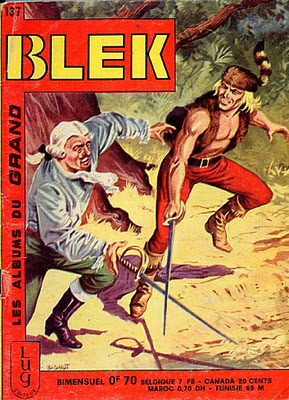
Alan Mistero is set in that generic Wild West which was home to so many Italian heroes. The title character is a brawny redhead who wears the classic cowboy boots, pants, and hat; but he doesn't wear a shirt. Instead he wears an open fringed vest. Alan wasn't the only Italian western hero to dress this way. Bonelli had a long-running frontiersman with the euphonious name Blek (another EsseGesse creation) who also favored a vest over a bare torso. However instead of a Stetson Blek wore a coonskin cap. I'm sorry, I think both versions of the style look silly.


Alan Mistero is a man of many talents which are often described in declamatory speeches from characters in the stories.
Of course he can outride, outfight, and outshoot anybody. He is also a master of disguise, a skill few cowboys can claim. Alan is followed around by two comical sidekicks. Polpetta (Meatball) and the Count come right out of the Registry of Standard Sidekicks. Meatball is the Comical Fat Guy Who Always Gets in Trouble. Meatball has your typical Andy Devine build and isn't well-supplied with wits.
The Count is the Comical Foreign Intellectual. He's a boastful Frenchman
who punctuates every other speech with "Tonerre!" or "Parbleu!" The
Count, who is almost always smiling, has pronounced circles under his
eyes. This plus his frequently manic behavior makes me wonder if he has a
secret drug problem.
Alan lives outside Wilcoxtown in a camp at the end of an "impassible
mountain trail." The camp is also home to "his Mohawk Indians." About a
dozen Indians live in Alan's compound. I'm not sure why. In the issues I
have all they do is say "Ugh!" and re-explain other characters'
dialogue.
Everyone in Wilcoxtown is familiar with Alan, though he doesn't seem to have
friends there. In the wider world few people recognize him, but everyone knows his reputation.

The overall cartoony approach of Alan Mistero's artwork carries over to
the stories. Gunplay and fistfights are of the rollicking Captain Easy
variety. There is no blood and little onscreen death. Lots of guns are
shot from hands and though many a blow to the head is delivered, nary a
concussion results. This fairy-tale setting makes it a little easier to
accept sometimes far-fetched stories with plot holes big enough to drive
a Conestoga through.
A unique feature is the prevalence of alcohol. An early story begins
with Meatball, stinking drunk, falling off a wall; and a surprising
amount of beer is consumed in 16 pages. One remembers how seldom 1960s
American comics named the liquids imbibed in their saloons. It appears
liquor may have been played down in later issues of Alan Mistero, but I
don't have enough samples to tell for sure.
Since I don't know when to leave well enough alone, I'll step you through an Alan Mistero story in the next post. After all, each of you is a prospective fan!
Labels:
Alan Mistero,
EsseGesse,
italian comics,
westerns
Wednesday, June 26, 2013
Fantax Fights a Bear
Somebody Else's Post
This odd post is for the benefit of Bully and his entertaining blog Bully Says Comics Ought to be Fun. Recently he's been treating us to Bear Attack Month. I had no idea bear attacks were so popular in comics...it's fun seeing the different ways bear attacks were worked into superhero stories...and the different degrees of skill the artists showed in depicting the critters. You should check the series out.
To demonstrate that American superheroes aren't the only ones who know how to deal with bears, I offer in Bully's honor an encounter from Fantax #26 (Edizioni Western, 1948). I haven't been able to figure out who the artist is. It may be Gallieno Ferri, or it may be Pierre Muchot (aka "Chott"), who originated the character in France. English version by Bearswacker.
SPOILER ALERT:
Fantax doesn't die.
This odd post is for the benefit of Bully and his entertaining blog Bully Says Comics Ought to be Fun. Recently he's been treating us to Bear Attack Month. I had no idea bear attacks were so popular in comics...it's fun seeing the different ways bear attacks were worked into superhero stories...and the different degrees of skill the artists showed in depicting the critters. You should check the series out.
To demonstrate that American superheroes aren't the only ones who know how to deal with bears, I offer in Bully's honor an encounter from Fantax #26 (Edizioni Western, 1948). I haven't been able to figure out who the artist is. It may be Gallieno Ferri, or it may be Pierre Muchot (aka "Chott"), who originated the character in France. English version by Bearswacker.
SPOILER ALERT:
Fantax doesn't die.
Labels:
bears,
Fantax,
Gallieno Ferri,
italian comics,
superheroes
Friday, May 10, 2013
Jacovitti's "Pa and Ma"
Marriage, Jacovitti Style
Taking my dictionary into my hands, I've made a stab at translating a couple of later Jacovitti strips. Pa e Ma is a concept familiar to American newspaper strips: a catalog of the miseries of married life. I must say Jacovitti takes misery to a level seldom achieved in American comics.
The Grattasassi family comprises Mr. Grattasassi, a henpecked accountant whose idea of heaven is sitting working crosswords; his ball-busting wife Giangiovanna, whose verbal abuse of her husband makes the Lockhorns seem an ideal couple; his daughter Georgina, a fiery student radical; his son Atilla, a super-genius; the baby Cicciantonio, who nurses on salames; Mr. G.'s horny old grandfather; their TV-obsessed maid Audia, and the family dog Eccellenza.
The family is bizarre to the extreme, but the art and many of the jokes are pretty funny!
Amateur translator's note: I was defeated by Mr. G.'s expletives. Some examples are "Mondo vigliacco!" "Mondo caimano!" etc. They really don't make much sense in Italian either. "Mondo" means "World," so the phrases translate as "Coward(ly) world!" "Crocodile world!" and so on. After trying many ways to approximate them in English I gave up and left them as they were.
Taking my dictionary into my hands, I've made a stab at translating a couple of later Jacovitti strips. Pa e Ma is a concept familiar to American newspaper strips: a catalog of the miseries of married life. I must say Jacovitti takes misery to a level seldom achieved in American comics.
The Grattasassi family comprises Mr. Grattasassi, a henpecked accountant whose idea of heaven is sitting working crosswords; his ball-busting wife Giangiovanna, whose verbal abuse of her husband makes the Lockhorns seem an ideal couple; his daughter Georgina, a fiery student radical; his son Atilla, a super-genius; the baby Cicciantonio, who nurses on salames; Mr. G.'s horny old grandfather; their TV-obsessed maid Audia, and the family dog Eccellenza.
The family is bizarre to the extreme, but the art and many of the jokes are pretty funny!
Amateur translator's note: I was defeated by Mr. G.'s expletives. Some examples are "Mondo vigliacco!" "Mondo caimano!" etc. They really don't make much sense in Italian either. "Mondo" means "World," so the phrases translate as "Coward(ly) world!" "Crocodile world!" and so on. After trying many ways to approximate them in English I gave up and left them as they were.
Thursday, April 4, 2013
Chip (Cip) by Benito Jacovitti
A Cip off the Old Block
I've spent a while working on this, so I hope it will please some readers.
Benito Jacovitti (1923-1997), though a legend in Italy, doesn't seem to have caught on in other countries. Certainly few American fans have heard of this crazy cartoonist, whose unique style and manic energy filled thousands of pages from 1940 on. Perhaps Jacovitti's use of puns and invented words contributed to this situation. At any rate, Jacovitti (usually signing himself "JAC") created lots of very funny, very weird, comics.
Jacovitti's first major gig was for the Catholic kids' weekly Il Vittorioso (The Victorious). He created many characters for them, including Pippo, the leader of a kid gang, and Cip l'arcipoliziotto, a cross between Sherlock Holmes and hardboiled private eye. What follows is Cip contro Zagar (Cip vs. Zagar), in which the detective grapples with his nemesis, super-criminal Zagar. In terms of the artist's career it's an early piece (1945-1946), before Jac had abandoned himself to cramming each panel with word play and joky detail. A beneficial side effect for the amateur linguist is that the dialogue is therefore easier to translate.
As mentioned above the Cip character (the name is pronounced "Cheep") began as a Sherlock Holmes parody. Cip's pipe is a token of that heritage. But Jacovitti's rough-and-tumble spirit was more suited to in-your-face characters, and the detective moved quickly into the hardboiled arena. He's quite a character: self-important, arrogant, bombastic, violent, often very stupid and never owning up to the fact that he's largely incompetent. He pretends to be cool and brave, but as we see here, Zagar scares the pants off him.
Cip and Zagar hint at the origins of Jacovitti's cartooning style. Cip himself is strongly influenced by Segar's Castor Oyl, and Zagar is Mickey Mouse's enemy The Phantom Blot. But Jacovitti's personality was so strong that he soon left influences behind. In this story his unmistakable character design is almost fully-matured. So is his obsession with sausages.
As an amateur translator I feel the need to justify a few things. First the names. I changed Cip to Chip because it's close to the original and easier to read in English. Other character names were changed for the same reason. Chip's sidekick was originally named Gallina, or "hen." With a nod to Douglas Adams I renamed him Roosta because it was still a chicken name and it sounded better than "Hen." I gave the dog Kilometro ("Kilometer") his original name because, again, it had a nicer sound. Jacovitti tended to give secondary characters rhyming names: Raimondo il Vagobondo (Raymond the Tramp), Mario il Veterinario (Mario the Veterinarian). I tried to give them English names that followed the same pattern. One exception was Easterly, the castle administrator. He started out "Pasquarello." Early on Jacovitti played on the first part of his name (Pascua=Easter) by having Chip call him "Nata-something" (Natale=Christmas). I called him Easterly to access some of those puns. Most troubling was Chip's label l'arcipoliziotto ("the arch-policeman.") It just doesn't make sense in English, where "arch" has come to imply evil (arch-enemy, arch-criminal). I finally gritted my teeth and called him "the super cop." While unlovely, it carries the original meaning.
But enough of this stalling. I hope you find as many laughs in this as I did, from the first page to its preposterous conclusion. It's show time!
This story was scanned from the 1974 reprint by Camillo Conti.
I've spent a while working on this, so I hope it will please some readers.
Benito Jacovitti (1923-1997), though a legend in Italy, doesn't seem to have caught on in other countries. Certainly few American fans have heard of this crazy cartoonist, whose unique style and manic energy filled thousands of pages from 1940 on. Perhaps Jacovitti's use of puns and invented words contributed to this situation. At any rate, Jacovitti (usually signing himself "JAC") created lots of very funny, very weird, comics.
![]() | |
| Jacovitti by Joe Zatt, from Wikipedia |
As mentioned above the Cip character (the name is pronounced "Cheep") began as a Sherlock Holmes parody. Cip's pipe is a token of that heritage. But Jacovitti's rough-and-tumble spirit was more suited to in-your-face characters, and the detective moved quickly into the hardboiled arena. He's quite a character: self-important, arrogant, bombastic, violent, often very stupid and never owning up to the fact that he's largely incompetent. He pretends to be cool and brave, but as we see here, Zagar scares the pants off him.
Cip and Zagar hint at the origins of Jacovitti's cartooning style. Cip himself is strongly influenced by Segar's Castor Oyl, and Zagar is Mickey Mouse's enemy The Phantom Blot. But Jacovitti's personality was so strong that he soon left influences behind. In this story his unmistakable character design is almost fully-matured. So is his obsession with sausages.
![]() |
| Source: Il Faro del Glifo blog |
As an amateur translator I feel the need to justify a few things. First the names. I changed Cip to Chip because it's close to the original and easier to read in English. Other character names were changed for the same reason. Chip's sidekick was originally named Gallina, or "hen." With a nod to Douglas Adams I renamed him Roosta because it was still a chicken name and it sounded better than "Hen." I gave the dog Kilometro ("Kilometer") his original name because, again, it had a nicer sound. Jacovitti tended to give secondary characters rhyming names: Raimondo il Vagobondo (Raymond the Tramp), Mario il Veterinario (Mario the Veterinarian). I tried to give them English names that followed the same pattern. One exception was Easterly, the castle administrator. He started out "Pasquarello." Early on Jacovitti played on the first part of his name (Pascua=Easter) by having Chip call him "Nata-something" (Natale=Christmas). I called him Easterly to access some of those puns. Most troubling was Chip's label l'arcipoliziotto ("the arch-policeman.") It just doesn't make sense in English, where "arch" has come to imply evil (arch-enemy, arch-criminal). I finally gritted my teeth and called him "the super cop." While unlovely, it carries the original meaning.
But enough of this stalling. I hope you find as many laughs in this as I did, from the first page to its preposterous conclusion. It's show time!
This story was scanned from the 1974 reprint by Camillo Conti.
Labels:
arcipoliziotto,
Cip,
il vittorioso,
italian comics,
Jacovitti,
Pippo,
Zagar
Subscribe to:
Posts (Atom)