Friday, August 3, 2012

British Cartoonists Album: Part 2

A Glance at English Strippers
Today we continue yesterday's stroll through the 1962 British Cartoonists Album. This will be the first of two posts focusing on the collection's sampling of newspaper strips. Strips in the Album come in two flavors: individual dailies placed among the cartoons, and proof sheets filling an entire page. We'll start with the former category and tackle the latter next time.

An inauspicious start: beneath a Clive Hudson he-she cartoon  are two unnamed strips by a cartoonist named Ghilchik. The lightweight jokes seem to depict the escapades of Boy Scouts. I found many online references to a cartoonist named David Louis Ghilchik, who was active at Punch during the 1930s. Could this possibly be the same guy? The style in his Punch work looks nothing like these strips.


Next comes a caricature of someone I don't recognize and an amusing gag by a Daily Sketch cartoonist named Rains. Below that is an interesting sample from a pin-up strip called Lindy, drawn by Ernest Ratcliff. I don't know how long this strip ran; Ratcliff apparently drew several British girl strips. He was also a magazine illustrator during the 1950s. This sample only hints at Ratcliff's abilities. Take a look at these two originals on comicartfans. Nice!


 I'm puzzled that while Lindy has a nice pin-up figure, her face isn't particularly pretty. I gather from this sample she's supposed to be a "tough broad" type; maybe this was extended to her character design.

An entire page is given to Trog's Flook. I can add nothing to the reams of material written about this British icon, except to wonder that anyone could have thought of syndicating this ultra-English strip in the USA (It happened!).


Beneath a funny gag by Spencer is a superb Carol Day daily by David Wright. I've never seen enough strips from any Carol Day continuity to get a sense of the stories. Various commentators have called them "brooding" and even "death-obsessed." However there's no question about the quality of Wright's art. For years he used the elaborate cross-hatched style shown here. Later he switched to rendering with overlaid Ben Day films. The art still looked great, but I prefer the earlier pen style, which ranked right up there with the great Gilded Age penmen. Carol has her own website, carol-day.com, with biographical info and tons of beautiful art supplied by Wright's son Patrick.

After Carol comes a typical episode of the seafaring adventure strip Tug Transom, which the Album misspells "Transon." Alfred Sindall's rough-edged, brush-based artwork was just right for the subject. Scripts were supplied by Peter O'Donnell. I was interested to learn that Sindall was the original artist on Paul Temple, though I haven't turned up any examples.


 Next are two gags by Burgin. Wrapping up the page is For Better or for Worse, a gag-a-day strip about a young married couple. Leslie Caswell's art seems a touch over-realistic for such a strip, but the closer you look the more there is to like. The chattering biddies in the last panel are wonderfully characterized. It turns out Caswell was more of an illustrator than a comics artist. He did many monochrome illos for various British magazines. Here's a nice overview of his work. For Better or for Worse seems to have run quite a while. It was later taken over by Frank Langford, another talented illustrator, who brought a more decorative style to the project. One web reference from 2008 said a "modernized" version of the strip was still running.


The frustrations of search engines hover over Twick by Digby Adams for the Thomson Newspapers. Overwhelmed by Twickenham, Digby the World's Biggest Dog, Douglas Adams, and companies named Thompson, I found nary a mention of this so-so married-couple strip.


Speakiing of married-couple strips, I get a distinct Dagwood vibe from The Daily Dees by Butterworth, though the art isn't that similar. Perhaps it's the Chic Young-style balloons, which are rare in British strips. I don't know anything about the artist. It surely couldn't be Jenny Butterworth, the Tiffany Jones artist. But it's she and Rick Dees who dominate the Google results.

The strip below the Dees is my nominee for the hidden jewel of the collection. I'd never heard of Colonel Pewter, but I was impressed by Arthur Horner's whimsical artwork. Thanks to the Web, I've learned that Horner was an Australian cartoonist who lived for many years in England. He wrote and drew the Colonel's adventures between 1952 and 1970. The more I read about this strip, which combined social commentary with fanciful adventures and odd characters, the more I want to read a long run. Here's an introduction on the "Ian T. Graphics" blog. Maybe I'll be able to scour up a (affordable) copy of one of the reprints.


Next post we'll scan a few proof sheets from noted English continuity strips.


Thursday, August 2, 2012

British Cartoonists Album: Part 1

A British Cartoonifest
I haven't posted for a couple of months thanks mostly to  a crisis of confidence with which I'll deal in a future post. Maybe. In the meantime I'd much rather talk about another old book that's surfaced during my never-ending excavation of the Great Garage.

I picked up British Cartoonists Album (no "the," no punctuation) decades ago in one of the little used-book stores that once dotted Los Angeles. In those pre-Internet days the Album was like a tiny window providing a tantalizing glimpse of a wonderful world that I would never get to explore.

It's always seemed to me that English comics are among the world's most woefully-underdocumented. Thanks to the World Wide Web the situation is improving, especially given blogs like those of Lew Stringer and Dez Skinn, men who are not only historians but also writer/editors who have worked in the field for years. Their articles have been an endless source of enlightenment. Even so, the sheer volume of English comics--newspaper strips, comic papers, comic books, annuals, etc. etc.--would provide years of material for an army of researchers.

The Cartooonists Album was published in 1962 by Anthony Gibbs & Phillips, Ltd. It was "prepared under the auspices of the British Cartoonists Club." No editor is listed, just the list of the club's officers, beginning with His Grace the Duke of Bedford.  The 128-page hardback is a smorgasbord of gag cartoons, political cartoons, and newspaper strips.  In most cases the artists, especially the political and gag cartoonists, are people I'd never heard of. Probably English readers will know many of them. Over the next couple of postings I'll offer glimpses of this cartoon treasure trove.

As a prelude, here are the book's vital statistics, followed by a listing of the featured artists. To my annoyance many of them are identified only by their last names. Fine in 1962, when everyone knew them, but less than helpful when you're Googling a cartoonist named "Lee."


This page offers two quite different strips. The first is Barley Bottom by Lucian. Believe it or not the only Web reference I've found to Barley Bottom is a 1963 article in The Catholic Herald describing a "harmless wart cure" mentioned in the strip. Obviously those are caricatures of real MPs in panel one. Can any English readers identify them? Of all the work in the book, Double Trouble by Brian White is the most old-fashioned. This isn't surprising: White was born in 1902. In the late 1920s his company produced animated commercials for movie theaters. Decades later he worked on the milestone animated feature Animal Farm.
 
On the left of the spread below is a  nicely-drawn political cartoon by the above-mentioned Lee. It's one of several cartoons basing its gag on corporal punishment in English public schools. The right-hand page features two cartoons by Bill Tidy. Tidy was one of the few English gag cartoonists I knew when I bought the Album. Earlier I had stumbled upon a reprint of his Fosdyke Saga strip. I love Tidy's stuff; his gags are consistently funny. His art style reminds me of Larry (also represented in the Album), but paging through the book I notice a number of gag men with similar styles. Was there a "granddaddy" cartoonist who influenced them?

 
Here's a nice find: The opening days of Jane, Daughter of Jane, drawn by Dutch cartoonist Alfred Mazure. This was one of several English "girl" strips done by this talented (and nearly forgotten) artist-writer. One of them was Romeo Brown, which "Maz" originated. That strip was later taken over by Peter O'Donnell and Jim Holdaway--you may have heard of them. Daughter of Jane was an attempt to re-create the success of Jane, the iconic World War II pin-up strip. Unfortunately it didn't catch on. On the right page are two gags by Leslie Starke, a Punch cartoonist, and an episode of Will Spencer's Animal Crackers. This amusing panel ran for twenty years and was syndicated overseas, including in the US.
 
 Wrapping up today's episode is a montage of really great stuff. First comes a John McNamara Paul Temple daily. I used to follow this strip in the Menomonee Falls Gazette. McNamara's layouts were a bit stodgy--just like the scripts--but his draughtsmanship was excellent. Lew Stringer posted some later Temples in which the venerable hero was redesigned to appear more up-to-date. The strictly-upper-crust stories didn't change, though.

Following McNamara are two panels by Arthur Ferrier, a legendary pretty-girl cartoonist. Ferrier is credited with pioneering the English pinup-strip in the 1930s with a weekly feature, Film Fannie. He did other weeklies and in 1953 did a daily strip, Eve.

I don't know anything about Vic Wiltshire. He may still be around: ebay.uk  offers many copies of a 2002 book by Derek Robinson and Vic Wiltshire, A Load of Old Bristle. It's a humorous illustrated glossary of Bristol dialect.

Winding up the spread is a smashing panorama from Tony Weare's Matt Marriott, reproduced criminally small. In fact my one gripe with the Album is its indifferent reproduction. The rough-surface book paper doesn't help, and too many illustrations are much too small. Later in the book several continuity strips are represented by syndicate proof pages--an entire week of strips shrunk to fit a page the size of an American comic book. Ouch!

Next post I'll show some of those strips, ouch and all.

Monday, May 14, 2012

Comics Irrelevancies--3

Dogpatch Shazam

Am I the only one who wonders if the Big Red Cheese is channeling Li'l Abner as he calls upon his will power?


Sunday, May 13, 2012

Comic Irrelevancies--2


Come Again? (Figuratively Speaking)

Beware--this is what happens to men with overactive libidos:

Comic Irrelevancies--1


They Don't Do This Anymore...

Browsing the fabulous Digital Comics Museum archive, I came across this on the inside front cover of an early-1941 issue of Whiz. The reproduction comes from microfiche, but it's still readable.

Two things strike one. First, that the comic lists complete home addresses of the would-be traders. Secondly, there are some pretty wild items for trade. Notable are several guns (shotgun, .22 rifle), a hunting knife, and a 16mm projector (its owner wants to trade it for a printing press). It's like the pre-war ebay.

I hate it when old fogies like me carry on about how things used to be different harrumph blah blah. But there's no denying some things have changed. No publisher would dream of printing kids' home addresses these days. Back in the late 60s Marvel did so in all their letter columns, apparently without major problems. I had a couple of letters printed, and never received sleazy advertisements or letters from pervs. On the contrary, I received a copy of Jerry Bails' legendary Guidebook to Comic Fandom, through which I was introduced to the world of fanzines and comics collecting.

Wait a minute! I was sent a gateway drug leading to fan addiction! Guess things weren't so safe even back then.

Friday, April 27, 2012

Bob Oksner--Comic Artist


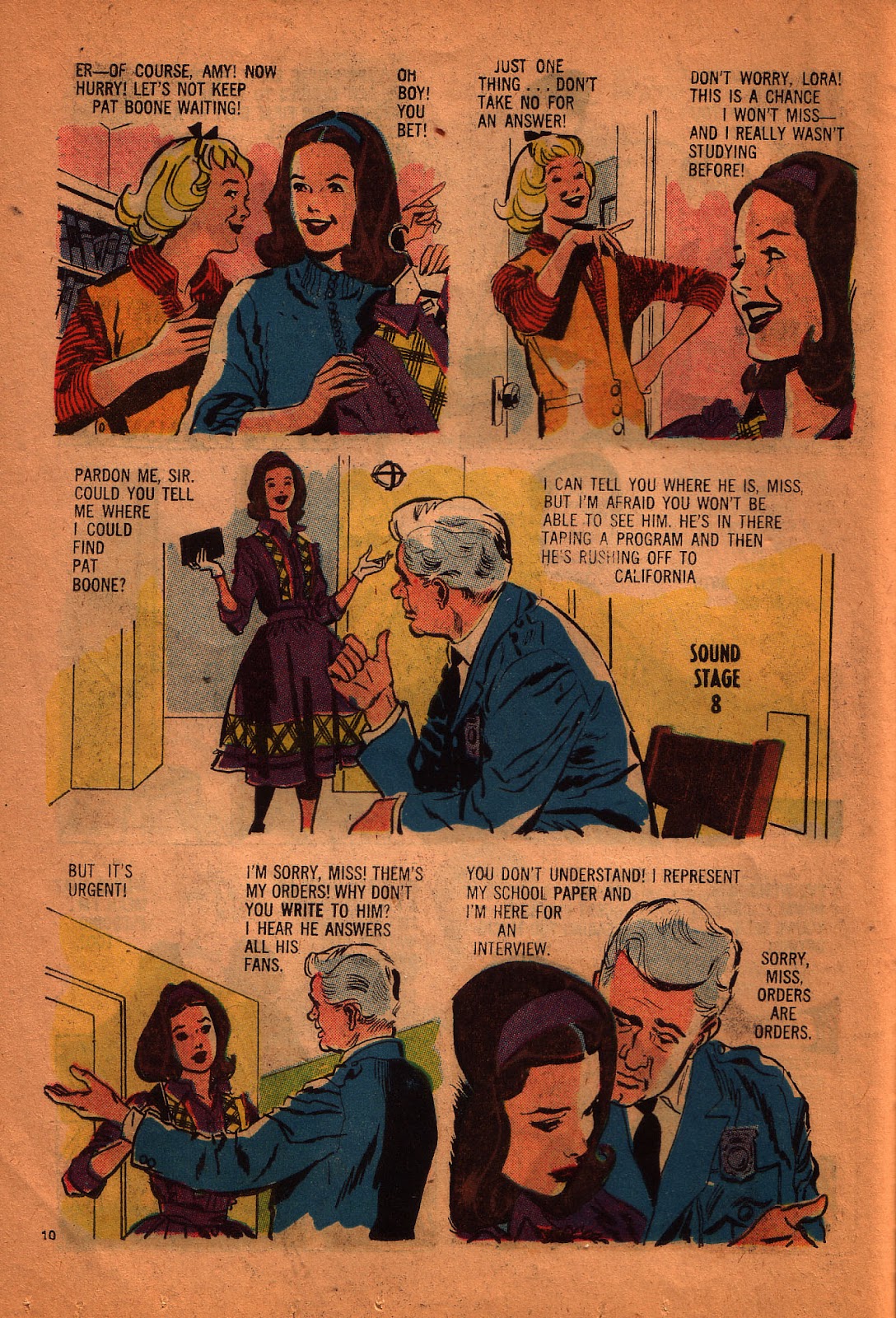
Bob 'n' Boone

I have only one (issue #2) of the five issues of Pat Boone, an oddball DC comic from 1959. Today when people think of 1950s pop music they think of Elvis and the early rock 'n' rollers. At the time, though, this squeaky-clean descendant of old-time crooners out-polled and outsold them all. This comic was part of DC's attempts to cash in on Pat's popularity. He also did guest shots in DC's regular titles, like Superman.

Though Pat Boone is in comic book format, it's more like a fan magazine. Numerous text features offer teen advice, record reviews, and celebrity bios. There are two comic stories, but even these go out of their way not to look like comic stories. There are no panel borders or balloons. Typeset dialogue floats in space with an occasional pointer if the speaker isn't obvious from the artwork.

The only reason to pay any attention to Pat Boone is Bob Oksner's superb artwork on the comic features. One concerns Pat's family life and co-stars lots of little kids. The other features Pat's fan base, teenage girls. Oksner draws in a more illustrator-y style than usual. Obviously he's working from photos, but there's so much spirit and skill in his drawings that the photo basis isn't overpowering.

Both stories are pleasing to the eye, but the lead story, the teenager one, takes the prize. The figures are full of life, with great posing and beautiful expressions. And the girls actually look like girls rather than the twenty-somethings who passed for teenagers in romance comics of the period.


Here's the story.


Monday, April 16, 2012

Thomas Kinkade, Painter

Some Kind of a Man


Paul Chadwick, Tom Kinkade, and Jim Gurney in a Polaroid
reference shot for a forgotten illustration.

In the days since the death of painter Thomas Kinkade I've been irked by the online outpourings of both his admirers and his detractors. The former gush syrupy paeans about Christian devotion and speaking great truths. The latter rupture themselves straining for the nastiest ways to express contempt for Kinkade and his fans. Missing is any attempt to see him as a human being.

Commentators mention specific events in Kinkade's life only as evidence supporting their opinions. Admirers dwell on his noble early struggles, his charity work, and his long marriage. Detractors prefer his shady business dealings and his drunken excesses. To both camps Thomas Kinkade is a mythical construct representing their interpretations of his art and career. Was the Painter of Light a paragon of traditional values and American entrepreneurism? Or was he a purveyor of schlock who preyed upon the booboisie? Neither, really. And both.

Those of us who knew Tom back before he got his "h," back in the crazy days of the art colony at the crumbling Golden Palm apartments, have been mulling over the arc of his life. How did the guy we knew become the millionaire commander of a beseiged outpost at the edge of the Culture Wars?

I was Tom's neighbor for several years while he was finishing his time at Art Center and working to establish a gallery presence. I was some ten years older than most of the "GP" gang. Tom Kinkade, Jim Gurney, Paul Chadwick, Alan Munro and the others were just leaving school when I arrived in LA. Despite my age I was at much the same stage in my career. Ever a late bloomer, I'd come to LA in hopes of finally finding a place in comics.

Because I never roomed with Tom or attended school with him, I didn't know him as well as Paul Chadwick. This memoir from Paul's blog offers a good account of the challenges of living with young Tom Kinkade. Since I didn't have to deal with as much BS as Paul, I ended up liking Tom more that he did. Still there was no denying that Tom was quite a handful.

The major theme of Tom's GP years was self-invention. He seemed obsessed with wanting to live like an Artist. He tried to dress an an Artist would dress, think as an Artist would think, do what an Artist would do. Determining exactly what that was became the focus of his existence.

Paul describes the manic energy with which Tom careened from one grandiose idea to another. Societies, styles, movements, enterprises...he'd dream them up and dissolve them in a single breath. But unlike many budding Artistes Tom wasn't all talk. He constantly dared himself to do the grand and crazy things that Artists would do, as if he had to prove to himself that he was indeed the Real McCoy.

His comrade-in-arms in this quest for the mythic life was his friend Jim Gurney. They fed off each other's energy, playing pranks, acting like loons, goading each other into wild stunts. They dressed in identical work uniforms (complete with embroidered name badges) and addressed each other as "Jackson." They played a non-stop vaudeville act, baffling us rubes with loud patter and dazzling us with the risks they'd take for art. One time they visited the seamy side of town and performed their floor show while sketching gang members. Another time they wore their matching work shirts to a notorious biker bar, sat down and began drawing the patrons without asking their permission.
Reference Polaroid of Ron taken by Paul
for a movie poster comp
Being terminally shy and a thorough coward, I often envied the exploits of "The Incredible Two-Headed Jackson Monster." But to tell the truth most of the time they could be a major pain in the ass. Stunt diving into the pool could be funny. Pouring a shellac "J" on my doorstep and setting it afire, not so much. The act broke up when the Jacksons married and found their wives weren't as fond of the team as the guys were.

I got to know Tom as well as I ever did while I was drawing "Dallas" and "Star Trek" for the Los Angeles Times Syndicate. I usually worked all night and slept during the day. Tom was on the same schedule, preparing for one of his first big shows. The Western Art Boom of the early 1980s was in full swing. Inspired by the work of Michael Coleman, Tom was painting romantic landscapes with a teepee or two added to lend a Western flavor. Back then he worked sitting before his easel, surrounded by a wilderness of sketches, photos, prints and clippings.

Tom was on some kind of impossible deadline--he'd committed to painting dozens of canvases in just a few weeks. This is where I saw a side of him that people seldom mention. He worked his ass off. True, he quickly developed a formula to speed the process along. But I assure you that Tom didn't just amble into gallery painting, he got there via the Long March.

Anyway, we'd both run out of steam around two A.M. For a break we'd stroll up the street to an all-night cafe. We'd talk art and watch drunks wander in as the bars emptied. Sometimes Tom would engage one in conversation, always with a kind of smirking superiority that made me uncomfortable. We frequently discussed the business of art. Tom had determined that the key to success was a winning formula and a huge output. He thought he might be able to get a whopping $300 per canvas, and if he sold enough of them--that's where the story always ended. Back then, at least, Tom wasn't envisioning an empire.

In those chats we covered a lot of ground: Victorian painters, color theory, comics, money, women. But I never got much of a sense of the "real" Tom. When he spoke of his past or his longing for his sweetheart Nanette, it always came out sounding like a story. It's as if Tom knew himself only through the same romanticized fables he told the rest of us.

After Tom married he and Nanette moved to Placerville, his old home town. He'd had some success and made a lot of contacts, but he was still a struggling artist. In Placerville he painted his first John Stobart-inspired city print. This was the famous print he and Nanette hawked in front of a grocery store. It was his first solid step up the ladder to fame. It was a nice painting. Tom gave Jan and me a print in 1985, when our son Joey was still a work in progress. He inscribed it to "Ron, Jan and Jr." The print hangs over our piano.

We visited Tom and Nanette at their Placerville home. Tom had built an enviable studio in the old barn next door. To Jan's annoyance (and I imagine Nanette's) Tom ignored the women so he could talk art with me. By this time he was full of plans--still no empire--and was confident of a great future.

We enjoyed one more visit with Tom and Nanette. Their first daughter was a just a baby. We spent a couple of days in a cabin in the magnificient Kings Canyon national forest. We had a great time. We talked (all of us this time), admired the kids, played with a friendly dog. Tom painted a skillful landscape while I struggled with starting one (I never learned how to paint outdoors). Tom offered advice and did a welcome paintover.

Years passed before we met Tom again. By that time he was a star. He invited us to a big bash in Monterey honoring his birthday. The show was fun in its way, but it was unmistakably planned by Tom to celebrate the Legend of Tom. He'd flown in a teacher he'd admired so the elderly man could say hagiographic things about him. He told larger-than-life stories about the GP days. He drank too much and became sentimental and noisy. After that party, he rose into the ranks of the super-rich and we never saw him again.

In an article in the late Thomas Kinkade's home town newspaper, people described major changes in Tom's life during the two years before his death. Nanette, now estranged after decades of marriage, said they'd split because Tom felt the need to "live the artist's life." Neighbors described him changing how he dressed, growing new facial hair, acting "differently." Could it really be that banal? After all the millions of dollars, the fame, the years of marriage, the sharky business, the drinking, after building the empire and watching it crumble--after all that, was Tom still trying on new costumes, still looking for an identity that fit him?

Which brings us back full circle to the lovers and the haters. What is it about humans that drives us to condense a person's life into a two-line caption that ties everything neatly together and explains all the inconsistencies? We build ridiculous straw men, selecting and rejecting aspects of complex lives in such a way that our final assembly makes a sort of sense. We confuse the man's paintings with the man himself. We pretend our myth man deliberately sent his works into the world to create the results we admire or revile. If we like the paintings, Tom was a saint who painted them to spread joy to the world. If we don't, Tom was a predatory swine who painted them to exploit the common man's gullibility.

Weren't Tom's paintings like every thing else in his life--reflections of the contradictory dreams and desires and fantasies inside his complicated head? Could Tom be friendly, generous, creative, even loving? Probably. Could Tom also be grasping, self-delusional, crass, even heartless? Probably. Contrary to the old saying, you can have it both ways. You must have it both ways.

Oddly enough I'm reminded of a movie. In Orson Welles' 1958 drama "Touch of Evil," policeman Hank Quinlan (Welles) destroys himself with evil deeds done in the name of good. At the end of the movie someone asks his long-suffering mistress Tanya  (Marlene Dietrich) what the man was like.

"He was some kind of a man," she replies.

Many critics took her statement to be the old American idiom expressing admiration. They wondered how Tanya, who knew Quinlan's depredations better than anyone, could admire him. Other writers--I believe they were the ones who caught Welles' real meaning--heard it differently.

"He was some kind of a man." She really didn't know. Hank Quinlan was the sum of all the things, good and bad, that he did in his life, and the sum made no sense. All he was--was something.

That's where I end up with Tom. Thomas. Thom. I want as much as anyone to force his life to make sense, but having known and liked him I can't take the easy way out by turning him into a symbol. What remains is that Tom was some kind of a man, and that's all I'll ever know.