Wednesday, November 24, 2010

GE Giveaway Comics

Adventures in Antiquity

Those of you who don't know goldenagecomics.co.uk ought to check it out. This site archives hundreds of rare old comics from a galaxy of publishers. One collection includes several of the giveaway comics released by General Electric during the 1950s.

These 16-page, cover-free comics feature Johnny, a red-sweatered high-school boy, and Ed, a business-suited know-it-all who never stops smiling. In each comic Ed takes Johnny to some place where they'll find lots of General Electric products and explains the related technology. One issue deals with the history of jet power, another the story of television, and so on. We learn during the course of the series that GE is a kindly, selfless benefactor responsible for inventing and/or developing almost all the life-simplifying technologies of the modern world.

I used to own most of these comics, but they went in the Great Collection Sale some 20 years ago. Finding them at goldenagecomics.co.uk allowed me to revisit the series and see if the art was as good as I remembered. Some of the GE books stuck in my mind as quite well drawn. In later years I doubted those memories, because the art was credited to George Roussos, who (as George Bell) had unimpressed the hell out of me inking early Marvels.

Thanks to Ger Apeldoorn and other bloggers, I've learned that early Roussos work was actually pretty good. Ger has questioned the common assumption that Roussos did most of his old comics work teamed with Mort Meskin. The GE comic I reprint here supports Ger's theory. The art certainly looks like Roussos, despite the faces on the main characters (which have a weird Lou Cameron vibe, but that's probably coincidence). The middle-aged men, a Roussos specialty, have his look. So does the drapery inking. I see no Meskin here, however.

Be that as it may, if this is George, it's one of the finest and most painstaking jobs he ever did. Good figure drawing is surpassed by even better background work, and the sheer effort he put into some of these pages (check out page 9) is impressive. Despite the fact that most of the story is walk-and-talk, this is an exciting old-school art job.

This comic, "Adventures in Electricity," is identified as "number seven" and bears a 1950 copyright date.


Tuesday, August 24, 2010

Who Drew the Green Hornet?

He Hunts the Biggest of All Game...Artist ID's!

Recently I found an online reprint of Dell's Green Hornet one-shot (Four-Color #496) from 1953. Behind a really nice cover is a really nice art job by someone I don't recognize.

[Is the Hornet kneeing that guy in the nuts in panel 4?]

I found only one guess online after a lot of Googling: Frank Thorne. This seems very possible. I'm unsure because the only other Thorne art I have from the period are the two Perry Mason Sundays I posted some time ago. These were drawn the previous year. The Mason strips are sketchier and stylistically more Raymondian. Of course Thorne may have used a more finished style on the Hornet. He also may have chosen not to emulate Raymond outside of Perry. Perry Mason was a King Features strip, after all, and Thorne's editors might have instructed him to follow Raymond.Whoever the artist was did a fine job on this book. For one thing he put research and effort into his locations:
He also avoided generic posing and character design. For example his version of reporter Mike Axford is a real individual:
One source noted that the two stories in the comic bore the same titles as episodes of the Green Hornet radio show. The commentator hadn't seen the comic but speculated the stories were adaptations of the radio scripts. After reading the stories I'm convinced he was correct. The pacing and dialogue are just like the radio play's. In addition the comic book writer (I believe it's Paul S. Newman and I don't think I'm mistaken) maintained the radio drama technique of having characters constantly call each other by name so the listener can keep track of who's talking. This "tagged" dialogue sounds kind of strange in a comic book.

Anyone know which artist is behind the Green Hornet's mask?

Tuesday, August 10, 2010

San Diego ComicCon 2010--2

Girls! Guns! G-Strings!
As I mentioned in my last post, one's skull would have to be numb indeed to miss the central theme informing a majority of ComicCon's displays: sexualized violence.

Years ago, in the days when panting fanboys were creating the concept of "good girl art," their quest was for scantier clothing and poky nipples. As the Market's inexorable drive for profit eroded the media's creaky self-regulatory machinery, we got what we wanted and then some: acres of flesh, scandalous action poses, and button-popping bosoms big enough to float the Titanic. Even then the groundwork was being laid for the next evolutionary phase. The mainstreaming of bondage fetishism and the rise of slasher movies helped cement the new role of newly-naked comic book women as sexy torture victims.

Of course the image of the beautiful, terrorized victim is as old as our patriarchal society. What's different today is its intensity and pervasiveness. At first one might imagine that the more recent wave of images of sexy women as perpetrators of violence emerged to balance out the powerlessness of the earlier sexy victims. Really it's just a variation on the same theme. They may pack guns the size of Volkswagens, but these busty amazons wear the same wire micro-bikinis, strike the same sweaty wide-legged poses, and twist their mouths in the same screams of pain. They still get raped, beaten, shot and flayed in page after lovingly-rendered page. The main difference is that after the abuse they carve their abuser's entrails out.

I can't buy the idea that this is all okay. The official line, supported both by leftist free speech advocates and rightist believers in unregulated markets, is that this fetishized misogyny is harmless. The mayhem is imaginary. People can tell fantasy from reality. Those who indulge in these fantasies achieve catharsis as well as orgasms. They would never carry their fantasies over into the real world.

My problem is this. Teachers have known for years that repetition and immersion change attitudes as well as increase knowledge. Propogandists have known for generations that endlessly repeating the same lie alters a target group's beliefs. With repetition and immersion cults brainwash members into doing everything from panhandling to killing themselves. Most significantly, advertisers have over a century of proof that repetition and immersion can make consumers lay out vast amounts of money on the stupidest products for the most irrational reasons.

Yet somehow this rule doesn't apply when it comes to the linking of sex with violence against women. Men don't become more physically and emotionally aggressive toward women. They don't become more tolerant of violence in general, or more inclined to abuse in their personal relationships. It's all harmless fantasy!

If someone can explain to me how that works I'd be much obliged.

Saturday, July 31, 2010

San Diego ComicCon 2010--1

Then and Now
So I survived a one-day trip to the San Diego ComicCon. I rather expected to be bummed out, as happened previously. Instead I had a great time. The reason? I reconnected with two old friends and coworkers I hadn't seen in nearly 15 years. One was Stefan Martiniere, genius illustrator and computer-game art director; the other Ricardo Delgado, ace of screen, print and fossil records. It was such a pleasure talking with them that I felt elated the rest of the day.

I had half-hoped I'd run into fellow bloggers like Joakim Gunnarson. Having made no advance plans and given that the convention center didn't do paging, I didn't stumble into any of them. At least I finally got to meet Don Rosa. "I've admired your work for years." "Thanks. And you're...who?"

I first attended the Con back when it was at the El Cortez Hotel. Its attendees were 99% fanboys. Today, as everyone knows, the Con's a cross between a trade show and an advertising spectacular. All the big media companies roll out their latest and biggest products in hopes of sparking positive word-of-mouth. All the little companies try hard to look like big companies. And everybody wants to sell you something. It's mind-boggling: books, clothes, weapons, statuettes, posters, prints, DVD's, and on and on. At ComicCon you'll see more ways to present violent images of nearly-naked, huge-breasted women than you imagined existed.

It's both ironic and sad that the Dealers--once the mainstays of comics-related enterprise--have been relegated to a tiny ghetto at one extremity of the hall. One still finds long cardboard boxes full of bagged comics (much more expensive than they used to be, of course!), but now selling used comics is a quaint sideline. ComicCon today is about comic book characters, to be sure, but not about comic books themselves. Other livelier media have overtaken them.

Other livelier marketers have overtaken the dealers, too. The really desirable old comics are hermetically sealed in plastic crypts which treble their value but make them difficult to read. Prices on primo original art have risen so high that I can't even feel sorry about being unable to afford them (e.g. paperback cover art for $30,000). Above everything towers Heritage Auctions, whose huge display included priceless Golden Age comics and an enormous (real) safe.

I was surprised there weren't more full-out geeks. There were plenty of shoppers, but the number of hardcore decked-out costumed sword-toting fanatics was small. This may have been due to the convention's recent policy of selling all tickets in advance. No more spur-of-the-moment "Hey, let's put on our Star Wars shirts and stand in line for three hours to get into the Con!" Advance buyers tend to be older, more organized, more goal-oriented, and more affluent than your typical middle-school geek. Still there were enough underclad lovelies wandering around to make it worth cleaning my glasses (not too underclad, though; the convention has rules about that sort of thing).

Amidst the din of the media promoting games, movies, comics, and web series, anyone with half a brain could hardly miss the theme informing most of them: sexualized violence. If you'd taken away the images of bloodthirsty seminude women holding huge weapons and those of terrified seminude women being tortured or butchered, the entire Con would have fit into the local Denny's. But more of this in another post.

When I'd had enough Con, I wandered around downtown. San Diego is a visually delicious city. Many of its oldest buildings were saved from development (mostly thanks to the town's reputation as a shabby Navy port) until people appreciated them again. A neighborhood of nineteenth-century structures has been sanitized under the name "The Gaslight District." Like most Old Towns the district is filled with restaurants, bars, and upscale boutiques. A wine bar seems to occupy every other corner. Conspicuously absent were the drunken sailors. In fact, during an entire afternoon's stroll I didn't spot a single uniformed Navy man, drunk or sober. I don't know where the sailors party these days, but it sure isn't in the Gaslight District. Most of the patrons of the sidewalk bars were young, hip-looking men and women with expensive watches and television wardrobes. They probably live in the many condos filling the area's old office buildings.

But old San Diego wasn't far away. You could still turn a corner and catch a faceful of the aroma of sewage, beer and urine. A block beyond the Gaslight District's border, homeless men idled in front of hollow-eyed office buildings that had thus far resisted gentrification. Here were the dollar stores, the (sleazy, non-hip) tattoo parlors, and the mini-marts. The all-night cheapie theaters, though, are all gone. Like the waves on the nearby ocean, affluence in San Diego ebbs and flows.

Next: Girls, Gore, and G-Strings!

Wednesday, July 21, 2010

Going South

It's Ho, Boys, Ho, to San Dieg-e-o
Barring a last-minute change of circumstances (or heart) I'll be going to the San Diego Comic Con this weekend. The plan is to be there Saturday.

What the hell will I be doing there? I dunno. I have nothing to offer...at least I can hope to meet one or two European bloggers who may attend. See you there. Maybe.

Friday, June 25, 2010

A Sight Unseeen--6

The Comic Section That Never Was--Over and Over Again

I've been digging through my garage looking for this item for months. Finally my labors have borne fruit.

I mentioned in an earlier post that I'd done comic-style artwork for an episode of the TV series Remington Steele. One of the props in that show was a fake newspaper comic section. Remington and Laura are fans of "The Blaster", an adventure strip supposedly produced by curmudgeonly cartoonist Raymond Kelly, but actually ghosted by his murderous assistant, Arte Wayne. Among the art I produced was a Sunday episode (in black and white) which presented the show's opening action in comic form.

The Sunday episode art was inserted into a mockup comic section that the post-production house had lying around. The post house was the Howard Anderson Company, a legendary post-production and effects company that has been around since 1927. It goes without saying this mockup had been around a l-o-o-o-ng time...no one remembered just how long. Whenever a client needed a phony comics section, Anderson stuck new art into an empty space on the mockup and ran off a new four-page "edition."

I'm not sure exactly how they did this. These were the days before large-format copiers and computer printers. They either had an old-fashioned letterpress unit or an offset printer which they fired up for these special occasions. The copy I have doesn't have the "indentations" characteristic of letterpress printing, so I'm voting for offset. It had to have been a big machine: the fake paper is the same size as a full-sized American newspaper spread.

I was fortunate to get a spare copy of the Remington Steele edition. I present it here for two reasons: first, to give everyone a look at this comic oddity; and second, to invite you Golden Era art-hawks to tell me who drew the other features. I'm sure there are some interesting stories buried here.

Here's page one:

The first strip, "Our Street," has a 1950s UPA look to it. The strip isn't very slick and like several other features has no story. To me this implies it was made specially for the section and not taken from some cartoonist's back stock of unsold strips. Bill Carter is surely an alias.

The second strip, "Casey the Cop" by Wally Bullock (another alias?), seems amateurish to me. Or is it just "stylized"?

The third strip, "Donny and Dolly Dewlap" could conceivably have been someone's unsold strip. It delivers a gag rather than being open-ended like the last two. 'Ted Baker' is too generic to take seriously.

The fourth feature, which has no title, is drawn in a capable early-1930s adventure style reminiscent of "Tailspin Tommy". The signature is interesting: 'Jan Grippe' is unusual enough to be a real name. Google turned up two references to a 1950 movie producer with this name, but I couldn't find the pages. Then there was a Jan Grippo (b. 1906) who co-produced the Monogram "Bowery Boys" movies. The sig could be "Grippo." Maybe he started out as an artist and tried to sell a daily adventure.

The last strip, "Captain Smith", is drawn in a competent 1940s semi-realistic style...except for the main character, who is Dick Tracy under another name. Though the episode has a beginning and an end, it doesn't seem like an unsold daily. "K. Lentz" means nothing to me. IMDB didn't have any Lentzes that made sense, and the name was too vague to make a meaningful Google search. The lettering on this strip is the most professional of the bunch; it has almost a Ben Oda look to it.

And now page two:

"Uncle George" by 'Max Morgan' (surely a fake name) could be from almost any time. My guess is 1950s. The art isn't exactly bad, but it ain't great either.

"A Day at the Fair" by 'Todd' is completely unlike any other strip in this potpourri. Whoever this guy is (the signature 'Michael Kent' sounds unlikely), he must have trained as a 1930s animator. Both character design and drawing style point that way. It's a damned nice job, too.

Look who's here! "Toby" is by none other than animator extraordinaire T. Hee (real name Alex Campbell). He signed his own name and got a byline. Among his many employers was UPA (early 1950s). Given the style of "Our Street", could there be a UPA connection to this paper? Or am I grasping at straws?

"Marty" by 'Herb Klynn' appears to have been drawn by a cartoony artist drawing straighter than usual. Something about it says late-1940s to me (could it be Marty's resemblance to the Bardahl man?).

"Snips and Runty" seems to be the top row of a real (unsold) Sunday page, although the signature is probably phony. Unlike most of the strips here, the lettering appears to be professional.

"The Rovers" intrigues me. Based on both the cartooning style and the heroine's dress and hair, I'd swear this was an unsold strip from the late 20s or very early 1930s. Its pacing suggests it's part of a longer story, and its subject brings to mind all those "Joe Palooka"-style strips. Google drew a blank on 'Leo Courey'.

Page three has a couple of features I know something about:

"Gerry" is likely the work of Gerry Woolery of Playhouse Pictures, the animation studio which contracted with the Steele team to supply art for the show. It was probably done on the spot to fill the hole to the left of "Sylvia Trace."

"Sylvia Trace" is, of course, two retouched "Dallas" dailies over which I lettered new dialogue. This was from my latter days on the project, when the late Thomas Warkentin was brought on as inker. You don't need a very keen eye to recognize J. R., Pam, Bobby, and Miss Ellie under those mustaches and glasses. Gerry agreed to my leaving Thomas' and my names on the strip, since Playhouse Pictures got screen credit for the Steele art, not me.

"The Blaster" is the fake Sunday I drew. Of course I signed it 'Raymond Kelly', but using my own signature style. Some friends who saw the episode thought I'd actually signed my own name to the art.

"Dinky" seems to be signed 'Ade'. It appears to be newer than most of these strips. It has that light, casual style that started in the 60s and continues to this day.

The fourth page of the mockup merely repeats the strips on page two. Now listen up, art spotters and strip historians. Who drew these strips? When? Why? Has anyone out there seen this comic section in other TV shows or movies? Get to work! And thanks.

Wednesday, June 23, 2010

Sostig the Pirate

It's Time-Wrecking Time!

Recently I've been re-reading my replica collection of early Albi d'Oro issues. Albi d'Oro was a post-WWII Italian comic book from Mondadori, reprinting features which had first appeared before the war in Mondadori's weekly children's papers. I especially enjoyed issue #199, “Sostig Il Pirata” (“Sostig the Pirate”), which originated in the late 1930s.

I don't know if Ray Bradbury's “The Sound of Thunder” was the first time-travel story to warn of the perils of changing history, but it certainly left its mark upon the genre. Ever since its publication, one hasn't been able to write about time traveling without considering unintended future consequences of things chrononauts do while in the past. Not so “Sostig the Pirate.” Its heroes violate time travel laws with the gleeful abandon of city folk out to teach the rubes a thing or two. The story's audacious disregard for anything but fun makes it an enjoyable romp, a relief from the earnestness of much time-travel literature.


“Sostig the Pirate” was part of an ongoing series called I Conquistatori del Tempo (The Conquerors of Time), scripted by Federico Pedrocchi and drawn by Giovanni Scolari, who had earlier collaborated with Pedrocchi on the legendary space opera Saturno Contro la Terra (Saturn vs. the Earth). “Sostig” is a self-contained sub-story within a larger arc called “Il Fiume del Fuoco” (“The River of Fire”), the second story arc in the Conquistatori saga.

In the first story arc, Professor Everton had invented a means of traveling through time. He enlisted hunky adventurer Trevor to lead an expedition into the past. The professor, his daughter Daly (Trevor's love interest), and a couple of fellow scientists survived a harrowing series of adventures in various eras before returning to the present. Now the professor finds himself a bit short of cash. Ever-resourceful Trevor offers a neat solution:

Of course Trevor forbids Daly to go with him, and of course Daly stows away and goes with him anyway. But more of this in a moment. Since he'll be facing bloodthirsty pirates, Trevor wants to be sure he has the stronger hand. So on his trip into the past he'll be taking along a fully-armed torpedo boat!

Not long after jumping back to pirate days, Trevor discovers that Daly has invited herself along on the voyage. Surprise!
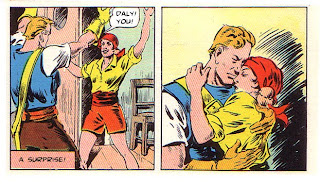
But although Trevor briefly turns into Flash Gordon when he welcomes Daly, this girl is about as far as you can get from the classic Dale Arden clinging vine. She's one tough cookie, a real scrapper, always ready--no, eager--to man the guns alongside the boys. She's also something of a hothead, as we'll see in a moment. But first, the chrononauts rescue a dying ship's captain who was set adrift in a dory after Sostig, a vicious pirate, slaughtered his crew. Before his exile the captain had heard Sostig planning his next attack, plundering a merchant vessel called the Mary-Joan..

The chrononauts have a mission. Their torpedo boat steams full speed ahead, reaching the Mary-Joan just as she's battling three of Sostig's ships. Our heroes flex their muscles and give the pirates a taste of 20th-century steel.

Sostig himself escapes. The time travelers raise their phony sails and head for Maracaibo, “the pearl of the Spanish empire.” Trevor and Daly go ashore to snoop around. They discover a proclamation from the local viceroy offering a 200,000 ducat bounty on Sostig. The loss of the reward irks Trevor. The pair decide to visit a local pub to dig for information. Trevor cautions Daly to avoid trouble, but she laughs him off: “I'm not worried! I was the Olympic women's fencing champion!”

Good thing, too. No sooner have the two seated themselves at “La Posada del Buen Retiro” than a brunette swordswoman greets them and makes eyes at Trevor. In time-honored Dale Arden tradition, the Green-Eyed Dragon immediately bites Daly. But like I said, Daly's something of a hothead:

A brawl erupts and the police arrive to break it up. A one-armed stranger helps Daly and Trevor escape the melee, but eventually they're caught and hauled before the law.

Another donnybrook ensues. The chrononauts and their new ally grab the post commander for a shield and fight their way to the upper floor. They find temporary respite behind a barred door. After gagging and tying the commander, they seek a rear exit. But when Trevor enters one room, he discovers a lovely woman--and gets another surprise.

A rather long flashback fills us in. Pedro, the one-armed man, had been a respected young officer in Maracaibo. Isobel was his beloved. Unknown to Pedro, the post commander also desired Isobel. He appointed Pedro to guard a shipload of pearls bound for Spain. Pedro protested that the course ordered by the commander ran straight through pirate territory. The commander demanded that Pedro obey orders, though he agreed to Pedro's insistence that the orders be put in writing. It turned out that the commander and the viceroy had plotted with Sostig to attack the ship, steal the pearls, and kill Pedro. Sostig would split the proceeds from the pearls with the treacherous pair, and the commander would have Isobel all to himself.

However it didn't quite work out that way. Sostig double-crossed them and kept all the loot. Though the pirate thought he'd killed Pedro, the young officer narrowly escaped death. Pedro lost an arm, but while on Sostig's ship he'd memorized a map showing the location of the pirate's treasure island.

The chrononauts quickly find Sostig's hoard, including the stolen pearls and Pedro's written orders. How about the rest of the treasure? “Of course the pearls are yours, Pedro, so you can complete your mission. As for the rest, we'll return whatever we can return. What's left over we'll divide between us.” Want to bet how much of the fortune was returnable?

Though Trevor's financial woes are at an end, Sostig is still at large. It's time to make him pay. The torpedo boat soon catches up with the renegade. Its deck guns blow Sostig's masts away. Then Daly and Trevor's machine guns feed the pirate crew hot lead until they agree to turn over their captain.

Sostig is gone, but there remains the matter of the traitorous viceroy and post commander back in Maracaibo. Anchoring beyond the range of the forts' guns, Trevor marches into the royal headquarters and demands the 200,000 ducat reward for Sostig--as well as a few other things.

You don't mess with Italians!

The commander sends his strongest warship out to punish the upstarts, but...well...

All's right with the world, Pedro is reinstated and marries his lovely Isobel, the treacherous officers have left town, and except maybe for several hundred dead soldiers and pirates, everyone's happy. On to new adventures!

Yep, they don't make 'em like that any more!