Friday, August 16, 2013

Guilty Pleasures: Alan Mistero


He's StilI a Mistero to Me
I  don't know what attracts me to clunky Golden and Silver Age Italian comics. Maybe it's their novelty. Maybe it's the glimpses I get into another culture. Probably it's because I have no taste. Understand, there were great Italian comics during this period. But if I were writing about them I wouldn't be calling them "guilty pleasures," would I? From time to time I run across a series that is so completely loopy I can't resist it. This time it's Alan Mistero.

I recently acquired several copies of this mid-1960s western adventure. It was a weekly about the size of an American comic. Each issue ran 20 pages including the covers, which were printed on the same mediocre stock as the interior pages. A cover banner boasted the book was "in color," but initially only the cover and eight inside pages were in color. The rest  were in black and white. Later the cover alone was in full color; the 16 interior pages were black-plus-red. The banner still said "in color" though.
 .

The stories were written and drawn by "EsseGesse," which was the pseudonym for a three-man studio. Dario Guzzon, Pietro Sartoris and Giovanni Sinchetto were important figures in postwar Italian comics. Beginning in 1951 they produced a ton of popular work which was solidly mainstream in both style and content. Historians recognize EsseGesse's contributions to comics history, but no one has ever praised their intellectual depth. 

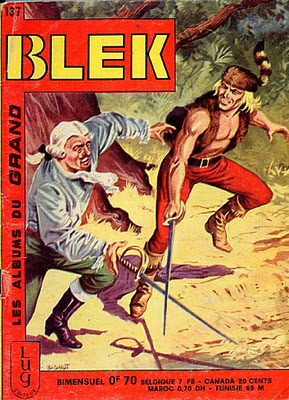
Alan Mistero is set in that generic Wild West which was home to so many Italian heroes. The title character is a brawny redhead who wears the classic cowboy boots, pants, and hat; but he doesn't wear a shirt. Instead he wears an open fringed vest. Alan wasn't the only Italian western hero to dress this way. Bonelli had a long-running frontiersman with the euphonious name Blek (another EsseGesse creation) who also favored  a vest over a bare torso. However instead of a Stetson Blek wore a coonskin cap. I'm sorry, I  think both versions of the style look silly.


Alan Mistero is a man of many talents which are often described in declamatory speeches from characters in the stories.


Of course he can outride, outfight, and outshoot anybody. He is also a master of disguise, a skill few cowboys can claim. Alan is followed around by two comical sidekicks. Polpetta (Meatball) and the Count come right out of the Registry of Standard Sidekicks.  Meatball is the Comical Fat Guy Who Always Gets in Trouble. Meatball has your typical Andy Devine build and isn't well-supplied with wits.


The Count is the Comical Foreign Intellectual. He's a boastful Frenchman who punctuates every other speech with "Tonerre!" or "Parbleu!" The Count, who is almost always smiling, has pronounced circles under his eyes. This plus his frequently manic behavior makes me wonder if he has a secret drug problem.

Alan lives outside Wilcoxtown in a camp at the end of an "impassible mountain trail." The camp is also home to "his Mohawk Indians." About a dozen Indians live in Alan's compound. I'm not sure why. In the issues I have all they do is say "Ugh!" and re-explain other characters' dialogue.

Everyone in Wilcoxtown is familiar with Alan, though he doesn't seem to have friends there. In the wider world few people recognize him, but everyone knows his reputation.

 
The overall cartoony approach of Alan Mistero's artwork carries over to the stories. Gunplay and fistfights are of the rollicking Captain Easy variety. There is no blood and little onscreen death. Lots of guns are shot from hands and though many a blow to the head is delivered, nary a concussion results. This fairy-tale setting makes it a little easier to accept sometimes far-fetched stories with plot holes big enough to drive a Conestoga through.

A unique feature is the prevalence of alcohol. An  early story begins with Meatball, stinking drunk, falling off  a wall; and a surprising amount of beer is consumed in 16 pages. One remembers how seldom 1960s American comics named the liquids imbibed in their saloons. It appears liquor may have been played down in later issues of Alan Mistero, but I don't have enough samples to tell for sure.


Since I don't know when to leave well enough alone, I'll step you through an Alan Mistero story in the next post. After all, each of you is a prospective fan!

Tuesday, July 9, 2013

Anybody Out There?

I will be attending the San Diego ComiCon this year, for the first time in a long time. If anyone out there will also be there, please comment me...I'd love to meet some of the Faithful 54. I'll be at the Con from Thursday night through Sunday.

Wednesday, June 26, 2013

Fantax Fights a Bear

Somebody Else's Post

This odd post is for the benefit of Bully and his entertaining blog Bully Says Comics Ought to be Fun. Recently he's been treating us to Bear Attack Month. I had no idea bear attacks were so popular in comics...it's fun seeing the different ways bear attacks were worked into superhero stories...and the different degrees of skill the artists showed in depicting the critters. You should check the series out.

To demonstrate that American superheroes aren't the only ones who know how to deal with bears, I offer in Bully's honor an encounter from Fantax #26 (Edizioni Western, 1948). I haven't been able to figure out who the artist is. It may be Gallieno Ferri, or it may be Pierre Muchot (aka "Chott"), who originated the character in France. English version by Bearswacker.

SPOILER ALERT:
Fantax doesn't die.

Friday, May 10, 2013

Jacovitti's "Pa and Ma"

Marriage, Jacovitti Style

Taking my dictionary into my hands, I've made a stab at translating a couple of later Jacovitti strips. Pa e Ma is a concept familiar to American newspaper strips: a catalog of the miseries of married life. I must say Jacovitti takes misery to a level seldom achieved in American comics.

The Grattasassi family comprises Mr. Grattasassi, a henpecked accountant whose idea of heaven is sitting working crosswords; his ball-busting wife Giangiovanna, whose verbal abuse of her husband makes the Lockhorns seem an ideal couple; his daughter Georgina, a fiery student radical; his son Atilla, a super-genius; the baby Cicciantonio, who nurses on salames; Mr. G.'s horny old grandfather; their TV-obsessed maid Audia, and the family dog Eccellenza.

The family is bizarre to the extreme, but the art and many of the jokes are pretty funny!

Amateur translator's note: I was defeated by Mr. G.'s expletives. Some examples are "Mondo vigliacco!" "Mondo caimano!" etc. They really don't make much sense in Italian either. "Mondo" means "World," so the phrases translate as "Coward(ly) world!" "Crocodile world!" and so on. After trying many ways to approximate them in English I gave up and left them as they were.


Tuesday, May 7, 2013

George Wunder Terry Sundays 1947--4

Bor No More!

Here's the conclusion of George Wunder's second Terry and the Pirates continuity. We see the surprising end of evil fat man Theodore Bor. Surprising to me, anyway--I mean, Burma never murdered anybody and got away with it!

20 July 1947

27 July 1947

3 August 1947

10 August 1947

17 August 1947

24 August 1947

31 August 1947

7 September 1947

14 September 1947

Sunday, May 5, 2013

Alfred Mazure, Artist and Writer

A-Maz-Ing Maz

Alfred Mazure
A while back I posted a Romeo Brown story drawn by Dutch cartoonist Alfred Mazure. Talented and prolific, Mazure worked as an illustrator, a comics artist, a novelist, and a filmmaker. I spent considerable time hunting for information about Mazure and his career. While I found a fair amount of material, there were frustrating holes in his story and not everyone agreed on several points. That aggravating Internet phenomenon, Read and Repeat, clearly affected several sites. For example those who described Romeo Brown as "a suave and sophisticated detective" obviously had never read a Romeo Brown episode.

Therefore the following is a work in progress desperately in need of input from others. I'd especially like to hear from Dutch readers with access to offline material that might clear up some points. This isn't Primary Source material. Please don't cut and paste!

Alfred Mazure began his art career in his native Netherlands, where he was born in 1914 (some sources say 1913). The self-taught artist's first comic creation, a detective strip called De Chef , appeared in 1932 when Mazure was only eighteen. It didn't make any waves.  Mazure spent several years wandering about Europe and Africa.

De Chef (source: Lambiek.net)

Upon his return "Maz" tried again. This time he hit paydirt. Dick Bos, which premiered in 1940, followed the adventures of a two-fisted private detective. The series got off to a slow start until Mazure hatched the idea of handing unsold copies out to school kids.  It was a brilliant move. Before long Dick Bos was a star. Mazure both wrote and drew the Dick Bos stories, which were printed in an unusual pocket-sized format, about the size of a pack of cigarettes, with a single panel on a page. Soon the character was on his way to becoming a national institution.

From a Dick Bos story (source unknown)
Unfortunately history intervened. World War II had begun in 1939 and the Netherlands had hoped to remain neutral. However in 1940, the same year Dick Bos debuted, Germany invaded and occupied the country. The Nazi government noted Bos' popularity and asked Mazure to turn the detective into an SS officer. They offered a blank contract and a print run of a million copies an issue. It's unclear whether Mazure was an active member of the Resistance or simply a sympathizer; either way he rejected the offer. As a result his books were banned.
1960s Dick Bos magazine (source: Lambiek)
Information about what Mazure did during the war is contradictory. Several sources say that he went into filmmaking. However some suggest he made films for the Resistance while others say he made films commercially, though without much success. He did apparently produce anti-Nazi comics and illustrations. Dutch readers, please clear this up for me. At any rate, after the war (1946) Dick Bos reappeared, first in reprints, then in  new stories. The series was a hit all over again, appearing in both comics and novels. It seems to be at this time that Mazure signed a publishing contract that haunted the rest of his days. As has happened so often in comics history, Maz got very little while his publisher reaped huge profits from Dick Bos' growing popularity.

Exactly what happened next is unclear. Mazure was obviously unhappy with his contract, but he seems to have continued producing Dick Bos.Two subsequent events combined to end his Dutch career. I'm unsure which came first.  One was a growing public sentiment against comics. The Ministry of Education accused comics of having a pernicious effect on youth. When, in 1948, a 16-year-old boy murdered his 15-year-old girlfriend, a media storm arose around his having been a comics reader. We Americans have heard this one before!

A second event damaged Mazure's personal reputation. For reasons I can't figure out, the artist got lumped together with a group of other creators alleged to have collaborated with the Nazis during the War. How this happened given his pro-Resistance work is a mystery to me. Again I beg Dutch fans with inside knowledge to fill me in.

At any rate, Mazure gave up and moved to England to start over. He worked there for over twenty years as an illustrator, author, and strip cartoonist.

Cover for a novel (source: Radboud Coll.)
 He tried several times to recreate his success with Dick Bos. In 1948, the Daily Mirror published Mazure's Sam Stone, a detective who resembled Dick. The strip lasted two years. I also found several references to another detective strip called either Bruce Hunter or Bruce Bunter. I haven't found samples of either feature. Hunter/Bunter supposedly ran from 1951 to 1953, which would have released him just in time to launch Romeo Brown in the Daily Mirror (1954). This strip established Mazure's reputation as a pretty-girl artist. Most of his subsequent projects involved sexy women. He left Romeo in 1957 to illustrate another "girlie" strip, Jane, Daughter of Jane.

Jane, Daughter of Jane (British Cartoonists Collection)
 This was an attempt to update the grandmother of all girlie strips, Jane, which had titillated British soldiers during World War II. The attempt failed. The artist's next project seems to have been another clothing-challenged daily called Carmen & Co. Of this strip I've found a single example on Lambiek.net.

Carmen & Co. (source: Lambiek)
Somewhere in here--around 1960, apparently--Mazure returned to Dick Bos, both in print and in a film. How this came about I don't know. Maybe he was desperate: there is no record of his having renegotiated his contract, and sources imply that Mazure was always short on cash. This new Bos material seems to have ended around 1967, about the time Mazure wrote three English-language sexy-spy novels under the series banner Sherazad. He also had one more fling with comic strip ladies in 1969-1970, when Mayfair published Lindy Leigh. Mayfair was a Playboy-style magazine, and Lindy appears to have featured more nudity and sexual situations than Mazure's earlier strips Again I haven't been able to find samples online.

Sherazad title page (source)
Alfred Mazure died in 1974. He was only 59 years old. His creation, Dick Bos, is recognized as an important part of Dutch comics history. An excellent site, dickbos.com, posts classic episodes and provides background about Mazure's career. Unfortunately a link promising further information about the artist is dead.

Unidentified strip from Arie K. Collection. Could this be Carmen?

Saturday, April 27, 2013

George Wunder Terry Sundays 1947--3

Four More from the War on Bor

I'm putting off my glimpse at Alfred Mazure to post a few more George Wunder Terry Sundays. The story continues as fat man--make that vast man--Theodore Bor and sexy viperess Ermine Toy try to take over an oilfield. Terry, Hotshot Charlie, and Pat Ryan don't think so.

22 June 1947

29 June 1947

6 July 1947

13 July 1947

By the way, if you want to see the entire storyline (but not all the art) of this and the previous story, check out The Digital Comics Museum. Charlton Comics (of all people) published three issues of George Wunder's Terry and the Pirates. In typical Charlton fashion they were numbered 26, 27, and 28. Also in typical Charlton fashion, the stories are wretchedly-printed chop-ups of Wunder's first two continuities. However you can get a look at the stuff that happened between the Sundays I'm posting.  This link will take you to the Charlton Terry page.