Tuesday, March 22, 2011

Stuff I've Done--5


A Generalist Saves the Specialists

A while back I praised Joe Horne's The Specialists, a forgotten gem from the early days of MTV's Liquid Television. Thanks to a tip from Mr. Bloody Mojo, I found that the entire series has been posted to YouTube. The first episode is here. Seeing the show again after all these years was a treat. It's funny how Joe Horne's designs, a radical departure in their day, look mainstream now--though still better than a lot of the stuff out there!

I'd almost forgotten that the ninth episode of The Specialists featured my one and only appearance as a cartoon voice actor! It happened this way. Joe was assembling episode 9 when he discovered missing dialogue. The actor playing Granfaloon, the millionaire with the missing poodle, never recorded his line welcoming Fifi home. It's easy to see how the line was missed, because after his introduction in episode 1 Granfaloon didn't reappear until the end of the story.

Anyway, Joe burst into the studio in a frenzy. The original Granfaloon was unavailable and Joe needed someone NOW to pick up the line. I happened to be sitting there and Joe said, "Ron! You'll do it!" He whisked me over to the recording studio and stood me in front of a microphone.

I'm not a voice actor, nor for that matter an actor of any sort. For the next half hour I stood there and sweated, repeating the line over and over while Joe pulled his hair out. Finally he got something he could use. Of course my voice didn't sound anything like the original actor. But that didn't worry Joe. He figured no one would remember what Granfaloon sounded like anyway. So in episode 9 when you hear, "Fifi! You're back!" etc., that's me. Once the artwork came back from the animators, Joe presented me with a thank-you gift: a cel of Granfaloon holding Fifi. It was a nice way to mark the end of my acting career.

Friday, March 18, 2011

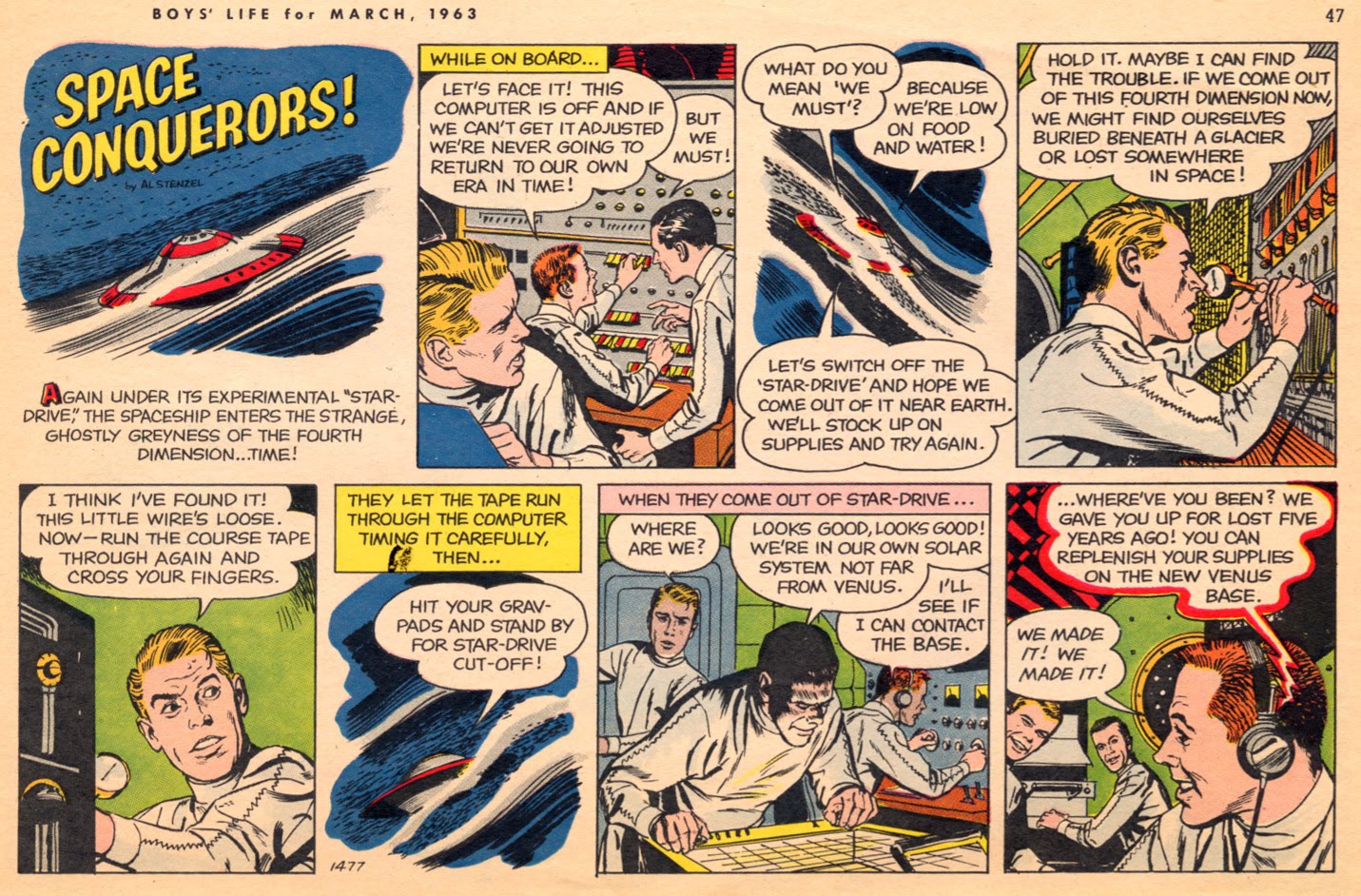
Space Conquerors!

A Fine Day in Space

When I was a kid I was a Boy Scout. I had a subscription to Boy's Life, a large-format monthly filled with short stories, fact articles, lots of ads for guns and...a comics section!

Naturally this was my favorite part of the magazine. The section ran full- and half-page color comics, their subject matter divided amongst fact, humor and adventure. I later learned these strips were produced by Johnstone and Cushing, the legendary comic art studio. At the time I was reading Boy's Life the section's roster included "The Tracy Twins," "True Stories of Scouts in Action," "Tono of the Longhouse People," biblical and historical one-shots, and my favorite, an s-f series called "Space Conquerors."
From my garage/midden I've recovered the handful of tearsheets I clipped from the magazine in the early 1960s. For years they'd been my only mementos of the series. Three cheers for the Internet! While googling in preparation for this post I discovered a complete index of the series with links to every episode in Google Books' run of Boy's Life!
I learned that the feature began in 1952 and went through several reboots as well as periods during which it simply presented astronomical facts. The story I'm posting turns out to have been the first episode of one of those reboots. It introduces three nameless astronauts exploring space in the first faster-than-light spaceship. Early episodes were rather tame, but later the series became a wild and woolly space opera. Not that the stories were very good: half a page per month made for sketchy plots and no characterization. It didn't help that the writer (presumably Al Stenzel) occasionally changed plans in mid-story.
This 1962-1963 episode was drawn by Lou Fine in his most generic style. Art on the strip was generally good. Fine had replaced George Evans, who had replaced the second of two guys I don't recognize. Fine drew several stories, then Alden McWilliams took over for a long run. After a surprise appearance by Gray Morrow, Fine returned. This time his art was more elaborate, though in some strips he seems to have been inked by another hand. Fine died in 1971, so the art variations may have been related to illness.According to Planettom, the series ended in 1972. However I swear that years later...maybe the mid-1980s?...I came across a copy of Boy's Life, now thinner and in a smaller format, and found an episode of "Space Conquerors" drawn by Ernesto Colon. Did I dream this? Does anyone know about post-1970s Boy's Life comics? Several later "Space Conquerors" originals are out there. Here's a nice 1964 page from Stephen Donnelly's collection. From near the end of the strip's run comes this one from 1971 which belongs to Alan Crouse. Both are by Fine.

Thursday, March 10, 2011

George Evans—Artist

Lost “Interview” with George Evans

While sifting through the endless piles of crap in my garage/midden I rediscovered something I never thought I'd see again: one of the two letters sent to me in 1974 by one of my favorite comics artists, George Evans.

Evans was one of those artists who spent a lifetime producing beautiful work, yet was always under-appreciated—mostly because his quiet style seemed dull in the light of flashier contemporaries like Wallace Wood and Al Williamson. Evans started drawing in the 1940s; drew comics for famous publishers like Fiction House, EC, Fawcett, and Dell; and ghosted George Wunder's daily Terry and the Pirates for decades before inheriting Secret Agent Corrigan from Al Williamson.

In the 1970s I was out of college and trying (unsuccessfully) to assemble an article about movie and television tie-in comics, particularly those published by Dell in the 1950s and 1960s. I wrote three men who'd worked on them: Alex Toth, George Evans, and Frank Thorne. All three responded kindly—and at length—to my questions. Evans was the most pleasant surprise of all. His letters were long, friendly, and chatty, providing loads of background information. The Toth and Thorne letters are long gone. Fortunately the surviving Evans letter contains much information about his varied career.

Following are excerpts from his letter of April 8, 1974. I've inserted italicized comments explaining my original questions. I hope genuine comics historians will find something to help them in their research.

First I asked Evans about how he became involved with Dell and how he went about adapting movies to comics.


Initially I did some stuff for Western which was an affiliate of Dell, or at least they worked together, though with separate editorial offices and people. At Classics [Illustrated] near the end their editor was Leonard Cole, who went on to Dell and asked me to go with him.
Panels from Oliver Twist, a Classics Illustrated issue Evans
drew with Reed Crandall

The first movie-related stuff I did was When Worlds Collide for Fawcett. Then the TV-related Captain Video. On WWC they just gave me a slew of stills, some of which I still have. I'd read the book and saw the movie, so with the stills, stayed close to what had been done. At Dell, they got stills, too; sometimes sheet after sheet of photo-size stop-action stuff, which is what they gave me for Tales of Terror. But they let me just interpret it loosely along the movie line, so I hammed up some of the stuff—and it was well received, so I guess if you have fun doing something, it helps communicate.
A page from one of the short stories in Dell's
Edgar Allan Poe's Tales of Terror (1962)

I asked whether he had begun to work with George Wunder at the time he was doing Twilight Zone, having noticed what I thought was Wunder influence in his work. He turned out to have started even earlier.

At Tales of Terror I had just begun to work with Wunder, through a quasi-agent named John Lehti; also, he was a cartoonist, and he abetted the inking of the last story there. And he was the one supposed to do Ivanhoe, but bogged down, so it was a botched and butchered patch-up job. I can't even recall which parts I did. I think he'd done bits everywhere that he had swipes for, or that fitted his abilities, and I hacked to a boring finish.

I asked him about his collaborations with Reed Crandall, which enlivened many a Classics Illustrated as well as Twilight Zone stories.


Reed and I held over from Classics. Reed had gone back to Kansas to help look after his mother. I special-air-mailed rough layouts to him; he put them in inking shape and zipped them back. We were pretty fast as a team, so somehow made our deadlines. Mail was faster then...and far more reliable, and much cheaper, too.
This page from an unidentified Twilight Zone story
was penciled by Crandall and inked by Evans;
both men were at the top of their form.

One time though he threw me a curve. I had penciled for him to ink, but he turned it over to a Frank Borth. And Borth simply inked what he felt like of the pictures, and erased what he'd left un-inked. I spent a lot of time putting it all back together myself. It was the semi-humor story to a Twilight Zone, and Reed had wanted a vacation—and Borth was a humor-cartoonist he thought he could trust.

I believe this story from Twilight Zone #4 (1962) was the one Borth worked on. Many of the character faces appear to have been touched by someone else. An interesting sidelight: half the final page was dropped to accommodate an advertisement. It wasn't until a reprint several years later that the page appeared in its original form.

I asked Evans if he could drop any names of editors or writers. Alex Toth had suggested Kim Aadmot wrote for The Frogmen, so I asked about him as well.

I worked through Len Cole, as noted. If others edited or whatever I never met them. In fact, Len lived at the edge of N. Y. City and would bring the stuff out so I could avoid the hassle of going in and wasting the extra time. Two names only come back to me as writers: Leo Cheney (think that's spelled right) who did the Twilight Zones and much s-f stuff. And Don Siegel (Sei-gel?) did The Frogmen. Don't know if he's the Don Seigel who is now a reputable name in movie making. Don't know Kim Aadmot. If he wrote Frogmen, it was after my time.

I was a great fan of the early Frogmen comic. I was puzzled about why the book's concept changed completely between issues: in the beginning the two heroes had families and kids and ran a skin-diving shop in the Northeast. At the time Evans left the book the families suddenly vanished without a trace and the heroes became globe-trotting adventurers.


Why did they change that? I have no idea. Maybe Mike Sekowsky just told them he wasn't drawing whole tribes of people. He seems to have a lot of clout in the business, and many friends, so it's a possibility [Actually Sekowsky took over after single issues drawn by Don Heck and Alex Toth]. Me—I get involved with the people I draw, and really thought of those two families as neighbors. Crandall helped me on the first couple—or the first, for sure.
This page from The Frogmen's first issue (O.S. 1258, 1962)
clearly shows Reed Crandall's pencils. The kids belong to the

two heroes' families, as discussed above.

I had been trying to identify the inker on the first Brain Boy and wondered if it had been Evans (I cringe to admit this).

No, I never inked anything of Gil Kane's, though he once phoned to ask me to do same. That's not my idea of things. Half-an-artist or less! I'd rather be a bad one on my own! Didn't do any writing on Frogmen, but sometimes Len and I talked about them, and sometimes in a story a faux-pas would turn up that I'd pick up and he and Siegel would smooth them out. Yes, Frank Frazetta helped me on a few pages of Frogmen, and quite a lot on the last Twilight Zone. He had just parted company with Al Capp, for whom he'd penciled the Sunday Li'l Abner for years. One of Capp's people had had a stroke, and out of a clear sky he ordered Frank to drop everything, move up to Boston and go full-time as a Capp ghost. Fortunately, Frank had the guts to say no—though he knew it was an instant cut-off, and he had a new house, a young family...He scraped by with his comics work while painting up the samples that launched his painting career. I'd turn green with envy watching the facile way he swept in color...

From The Frogmen #2 (1962) comes this knockout
example of Frank Frazetta lending his special touch
to the inking.

From Toth and Thorne I'd heard interesting stories about restrictions on likenesses and other contractual nonsense. I asked Evans about his experiences.

I don't know about all the technical and contract details, but of course they had to negotiate regarding copyrights. Use of stars' likenesses was probably covered in the stars' contracts with the studios. Probably they got nothing extra, in the same way Laurel and Hardy got not a cent extra as they became the most popular comics on TV.

It was possible to have at least some of the films run at private showings. Not bang-bang; but when a group of somehow-involved people (cartoonists, advertisers, critics, etc.) could be assembled. I saw the Hercules stuff that way. Became a big man in my older daughter's eyes when I magnanimously took her with me—and she gloated about it around the neighborhood kids! Other stories they sometimes got the entire storyboard from the film company's art department. I saw the storyboards for 20,000 Leagues etc. or some undersea story. On charcoal paper with litho pencil. Loose but very handsome. I was surprised they weren't in color. Wonder if there was another in color—as for color movies you'd think there'd have to be planned color composition.

Stills were given but so far as I know, didn't have to be followed, though doing so made easier work. Likenesses were never questioned, at least to me. And since I saw many books that simply used the assigned artist's “standard” faces, with only a slight bow to actual actors, I guess no one cared. Maybe they preferred that. How could the stars make trouble if they weren't used?

From O.S. #1328, The Underwater City (1961). Not the best page
from the book, but chosen because George Evans invited himself
along on the government's inspection tour of the undersea installation.
That's him in the green suit in panels 3 and 5.

I asked about his adaptation of a minor film, The Underwater City. This comic was another personal favorite.


I did Underwater City on my own, completely. Did enjoy it, though afterwards felt I missed the likeness to the hero, Wm—who? [Lundigan]. So far as I ever knew, it had no connection with my doing Frogmen, but then it might well have in the editorial rooms. I don't do any diving, but I am spectator-interested, and among the neighbors some of the athletic types dive, and we quacked a lot about it; and of course equipment was available for reference. The shore is only nine miles off here, and there's a lot of surfing and diving. Was, anyway, when I needed reference. It's getting polluted, too—so maybe it'll be kaput, too. But lotsa boats of all kinds, all the scenery. And many completely fruitless fishing expeditions with friends on various boats all went into Frogmen.

A beautiful page from The Frogmen #3 (1962).

Did he like doing movie comics any better than other books?

Depended on the story. I always yearned to do things like the James Bond stuff—or the “Flynn” ones [I think he was referring to Our Man Flint]. But one editor told me the girls I drew were not slutty enough for that sort of thing. Don't know whether that was praise or criticism.


Have had discussions on comics related to movies or TV characters. Including with Wunder. It's a really tough question. Takeoffs on one-shots possibly have a place—but then I think the story should sort of take-off from the movie story, just as movie versions often veer away from successful novels on which they're based. To just re-tell the same story—especially using the same stills as basic pictures—would seem dull. That's why I tried to ham it up, or make it a little more expansive. Adaptations of successful series characters to series comics would seem to me too much maturation—and bad for both. Any failure on the part of either turns the money-oriented producers sour. And yet I do think some comics should have continued around series characters even though the TV thing failed. Or was slaughtered. Star Trek as a perfect example.
It's not a movie book, but to wrap things up I couldn't resist
adding this page from Evans' Classics Illustrated retelling of an urban legend
about a ghostly hitchhiker.

I think the best idea for comics is to originate stories that go beyond where movie or TV stories go. I don't mean that in the curent sex and/or slaughter stuff, for I don't see how you can go any farther with either! But as an example, the funny story that was always included in the Twilight Zone. Nothing was too ridiculous, as long as it could be drawn, where making props for the TV version would've been too expensive, and too phony.

Dell was good to me, though as said back yonder I dealt only with Len Cole. I was much closer to the affiliated Gold Key, and really liked the group of people up there. I hope that was mutual. In fact, I must say that among the comics publishers I have worked for I've found very good people. I understand that was not so in all companies. I was lucky—and I was a little bit choosy, too; and, of course, friends in the business—artists, writers—steered me to the good people. People like that are good friends.

*****

Just reading his letters you knew George Evans was a nice guy. Everyone I've seen quoted who knew him confirms that fact.

In closing let me point out that he seems to have got the Dell/Gold Key thing slightly muddled. The Hercules book he mentions and the Twilight Zone one-shots were published by Dell Comics when it was still connected with Western Printing. However Frogmen and the Tales of Terror adaptation was done after Dell and Western had parted company. As I understand it, it was during this period that Leonard (L. B.) Cole was editor. The non-Western Dell continued the numbered One Shot series for a while but soon switched to releasing tie-ins as unnumbered issues.

There seem to have been two distinct periods of non-Western Dell. The first (the Cole period?) is known for off-beat series like Brain Boy, Space Man, and Kona. Most still featured painted covers. Frank Springer, Paul Parker, Gerald McCann, Jack Sparling, and Sam Glanzman were among the artists.

At a certain point the line changed again: painted covers were replaced by line drawings, ongoing series were canceled, sometimes after a couple of reprinted issues; and writing and art teams changed. Some earlier artists like Springer and Sparling continued with the new Dell, but the new crew featured many names familiar to Charlton readers: Sal Trapani, Tony Tallarico (with Bill Fraccio), Dick Giordano, the Vince Colletta studio, Steve Ditko, and writer Joe Gill. During this period Dell experimented with new series like Nukla, Super Heroes, and Flying Saucers. Most died after three or four issues. I speculate that the change was due to a change in editorship from L. B. Cole to D(onald). J. Arneson. At least it was Arneson who signed a reply to my letter of comment regarding Nukla. But that's a subject for another time.

Friday, February 18, 2011

Lives of the Artists

Mad Painter's Scandalous Escapades Revealed in Court Docs!

Those interested in misbehaving geniuses mustn't miss this article on the BBC website.

I've always liked Caravaggio's work, and was intrigued by his rotten reputation. It's amazing to think that police records like these have survived hundreds of years! Lindsay Lohan's will vanish in a few years when our digital media erodes.

I was disappointed to hear Caravaggio died in a hospital. I preferred the tale (knowing it was too good to be true) that he'd died of a heart attack while running down the beach, screaming at a boat that was taking his possessions away. A fitting way for such a hothead to cash in.

Thursday, February 17, 2011

Frank Follmer's Naughty Disney

The Mystery of the Disney Orgy This post is really a comment about a post on Joakim Gunnarson's blog, Sekvenkonst. My comment was so lengthy that I thought I'd waste my own storage space rather than fill his. Unless you read Joakim's post and its comments, this won't make much sense. So please put down your pencils and read them now. I'll be here when you return. Welcome back. As you see, the question is whether former Disney artist Frank Follmer was the original source of Wallace Wood's infamous "Disneyland Memorial Orgy" which appeared in the underground publication The Realist in 1967. An online dealer has put a large stock of Follmer's dirty drawings up for sale, accompanied by a glowing biography suggesting the artist was a seminal contributor to Snow White and deserved a place in the pantheon shared by Disney's "Nine Old Men." Who Was Frank? Some Googling turned up a handful of credits for Follmer, mostly as an effects animator in cartoons and shorts. So Follmer existed and did indeed work for Disney in the 1940s. So far, so good. Several collectors on the "Comic Art Fans" display vintage Follmer pencil drawings like this "storyboard drawing from Snow White:" I have no reason to doubt their authenticity, but three things puzzle me. First, these drawings aren't in the Disney archives. The company is famous for holding on to their production drawings. Second, each collector's comments about Follmer are nearly identical. This suggests that the drawings were all bought from the same source (the hagiograpy-writing art dealer?), which prevents cross-checking. Finally, as Joakim points out, the artist doesn't draw very well. Now, not everyone needed to be a top-notch draughtsman to work at Disney. But check out the Disney historical books. The company's board artists were very good indeed. After all, the studio was at the top of its game. It attracted the best talent. So I'm struck by the poor perspective and lifeless drawing in the storyboard panel. Consider also this sheet, offered by a different online vendor: These are copies from vintage model sheets we've seen before. They're better than I could do, but they wouldn't have rated very highly at 1940 Disney. What does this suggest? That Follmer was a minor Disney artist who liked to draw the studio's characters, but wasn't nearly as important as the dealer advertises. Dating the Dirties On to the main question: Did Follmer originate the Disneyland Memorial Orgy? You've already seen several of Follmer's versions of the scene on Joakim's site. For analytical purposes we'll use the black-and-white one, the only one with a date. The legend reads: "The boys in the animation department--1955." Obviously Follmer liked the theme of this piece, because he created endless variations. I presume this is not his earliest version. In a 2009 post on the Realist site a contributor calling himself "John Collector" wrote: "Few people know that Frank Follmer was the original artist[of the orgy]. Wally Wood recreated the original for the Realist #74 [in 1967] one month after Walt Disney passed away. Paul Krassner owns the copyrights and often claims he inspired the work, but I have several original versions of this piece purchased directly from Follmer in the 1950s on Disney studio paper dated 1940." There's no reason to doubt the gist of the story, but the dates are tricky. John Collector says the original versions dated from 1940 and he purchased them "in the 1950s." If we accept Follmer's date on the black-and-white piece, 1955, then John Collector bought the drawings between 1955-1959. This and several other drawings feature Sleeping Beauty's Castle, landmark feature of Disneyland theme park, which opened in 1955. Presumably all Follmer drawings with that castle were made after 1955. Moving back in time, Alice in Wonderland and Peter Pan were made in 1951 and 1953 respectively. No versions including those characters could pre-date 1951. By the same token, Bambi appeared in 1942 and Dumbo in 1941; any versions with those characters were created post-1942. Sorting everything out, it appears that Follmer produced the Disney orgies now on sale in the late 1950s. This doesn't preclude the possibility that he did do a version in 1940. It just means that such a version isn't among the current lot. Ours Is But to Wonder Why Why did Follmer do so many of these things? If the original had been simply a prank to amuse his fellow artists, Follmer probably would have drawn a copy or two for friends, but that's all. Maybe he planned to sell them. If so, he didn't do very well considering how many he had left to sell to John Collector. Was he simply obsessed with Disney characters fucking? After all, some fan artists are. If so, why didn't Follmer invent new poses for the participants instead of using the same ones over and over, flopping one occasionally? We may never know. Finally, why would Follmer misrepresent the dates of his work? Many minor old-timers have told fans stories to make themselves seem more important than they were. Follmer might have been one. Or he may not have misrepresented the dates at all. He could have been vague about dates and John Collector, like many dealers, filled in the details from his imagination. Did Woody Do It? I began this ramble intending to find that Follmer had copied his orgies from Wood's Realist drawing. I've changed my mind. Wood drew his poster in 1967, so all Follmer's work would have to come after that date, and all John Collector's information would have been lies. A gut feeling tells me JC was gullible, but not an outright liar. He wouldn't stand to lose much by admitting that Follmer drew his orgies in 1956. That was still a decade before the Realist drawing. He had no need to fabricate an elaborate backstory dating to the 1940s. On the other hand it's easy to imagine counter-culture publisher Paul Krassner stumbling across a copy of this underground masterpiece and viewing it as an anonymous cultural artifact like the "What Me Worry" kid. He hires Wood to clean it up (in the artistic sense only). Krassner could easily believe he "inspired" the work because he was the one who found it and introduced it to the Age of Aquarius. That's All, FFolkes... How close is my analysis to the truth? I'm just another fanboy...we won't know until old-timers who knew Follmer weigh in to either confirm or refute the dealer's version of the story.

Wednesday, February 16, 2011

Stuff I've Done--4


Evaporated Liquid

A long, long, time ago in a world far, far away, it was 1992. I was working with a small TV animation studio. Word came that MTV, then the outermost molecule of the cutting edge, was seeking short animated series for its hip new anthology, Liquid Television. Everyone in the studio, even me, was invited to bring their ideas to a pitch meeting.

Even back then "hip" was not what I was. If I'd been any less hip I'd have needed replacement surgery. So I decided just to be myself. I prepared two boards to present my personal mixture of art deco, obscure reference, and word play. My series was to be called Flab of Fury, Sword of Doom. It was set in a city called Decotropolis, which name I think has since been used by someone else.It's easy to tell the age of the proposal by its references: those were the days of Lone Wolf and Cub and a dog called "Spuds" who starred in Miller Light Beer ads. Mexican wrestling was still a niche genre, almost unknown outside Los Angeles.I liked my idea, naturally, but it definitely wasn't what MTV was looking for. However our company did place a series on Liquid Television: Joe Horne's The Specialists. Joe is one of the many unsung talents of TV animation. He's still in the business--he has directed dozens of series from Disney's Teamo Supremo to Boondocks--but few people remember The Specialists and its equally brilliant MTV forerunner Stevie and Zoya. We had no idea what our competition would be, but we were all confident that The Specialists would be a smash. It was clever, it was hip, it was loaded with cultural references, and at the time its visual style was absolutely unique.

Which goes to show how wrong you can be. The Specialists got barely a nod. The MTV audience doted instead upon an animated comic-book fantasy called Aeon Flux. You may have heard of it. But there was one short that even the hippest of us thought was the ugliest, stupidest, and most worthless of all the Liquid Television contenders. This was a one-shot called "Frog Football," and it introduced two characters named Beavis and Butt-Head.

Tuesday, February 15, 2011

Chinese Revolutionary Painters

The Paint is Red

Years ago a friend gave me a monograph about one of the State painters of Mao Tse Tung's China. Over time the poorly-produced booklet fell apart. All I have left are the color pages from the center. It's just as well, because (regrettably) I don't read Chinese. It goes without saying that I have no idea of this guy's identity or biography.

His work is typical of the "social realist" painting which flourished under China's Communist government. Intended as propaganda vehicles, these works celebrated good-looking men and women involved in labor and national service. The paintings appeared in books or as inspirational posters in factories and schools.

There seem to have been three broad styles of Chinese revolutionary art: a flat-colored approach which seems to owe much to classical Chinese art and block printing; dynamic black-and-white pictures which resemble mid-20th century Western magazine illustrations; and full-dress oil paintings stylistically rooted in conservative European art of the late 19th century.

It's interesting to see a work-in-progress demo of one of the artist's oils. The approach is solidly academic: a fairly complete charcoal drawing, a wash-in using sepia tones, then opaque color worked over the underpainting.(The finished painting is the image at the top of this post)

Also interesting is the way that the subject's face changes from drawing to finish. In the drawing he's a typical good-looking Chinese man. During his transformation into a hero the model's face loses most of its ethnic traits. I've been puzzled by this before. Many Chinese revolutionary painters seemed to employ an idealized "revolutionary hero" face which didn't look very Chinese.

In the following landscapes the artist treats a factory scene, a traditional landscape, and a river view with a pleasant Impressionistic style.

Here are a lively head study and a sketch of a plaster cast (nice reflected light):These two heads may be details from larger works:Finally come three propaganda works. The picture of the miners caught my eye. In the handful of books I've seen reproducing Chinese revolutionary art appear dozens of paintings glorifying noble (and unusually clean) coal miners. It's kind of creepy in light of the many Chinese mine disasters over the years.Thus does another anonymous illustrator enter the blogosphere. If someone out there knows his name, or can translate the captions, I'd love to hear from you!