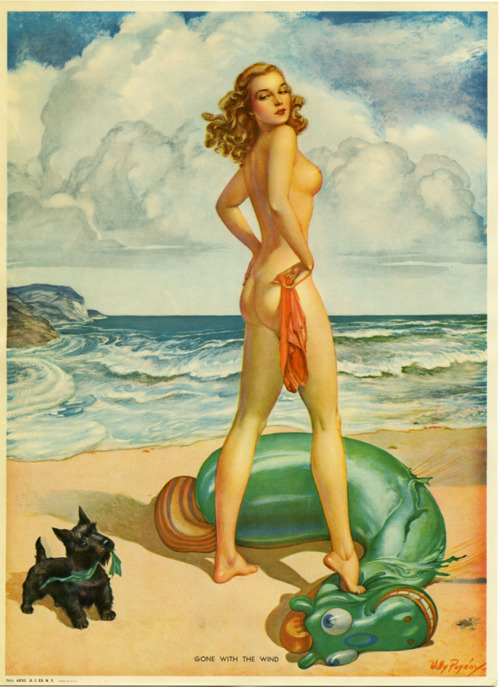
Thursday, April 12, 2012

Willy Pogany Retrospective

Willy Pogany, 1882-1955

 A Longer Look at Willy Pogany
After my last post a friend wrote to say he'd been familiar only with Willy Pogany's Art-Nouveau-inspired illustrations for Padraic Colum's books. It was a great excuse to share just a few of the works of this prolific and remarkably versatile illustrator.

Willy Pogany was born in Hungary in 1882. After studying art in Paris he moved to London where, beginning in the early 1910s, he built a solid reputation as a book illustrator. He married and moved with his wife to America. He was naturalized as an American citizen in 1921. Here's a link to Pogany's Wikipedia biography, which includes several useful links if you want to learn more about him. It also tells how to pronounce his name.
Cosmetic Ad, 1923

From his "Watercolor Lessons;" probably from an earlier illustration
Most of the pictures I'll show here I found scattered about the Net. Googling Pogany images is a great adventure--the longer you look the more incredible stuff you find!
Red Cross Magazine June 1919
Pogany's two outstanding characteristics were his versatility and his amazing stylistic range. He illustrated books, art-directed major Hollywood films, sculpted, did magazine covers, designed private rooms and stage sets, painted murals, taught, and wrote books. It seemed as if every art project he undertook, he produced in a style unlike all the others. This is why it's so much fun to hunt for his images. You'll find realistic and stylized, cartoony and grandiose, elevated and lowdown, in every medium. What I show here is the tip of the iceberg. Stick around after the show for a special treat: a personal appearance by The Man himself.
From one of his versions of the Rubaiyat of Omar Khayyam (he did at least two)

 "Amethyst" from a birthstone series for American Weekly

 Mother Goose--a remarkable design/illustration project

 Tannhauser

 "The Wishing Ring Man," 1917


"Sapphire," another birthstone from The American Weekly (1945)


Faust

American Weekly, 9 Mar 1947, featuring Snow White and Rose Red
From Ladies' Home Journal

One of several terrific covers for Metropolitan Magazine--circa 1916

Another great Metropolitan cover, Aug 1916

Willy shows his naughty side. Source unknown

The Taming of the Shrew

From his "Drawing Lessons" book--these were studies for one of his Omar Khayyam books

Spectacular sirens...kind of sloughed off Odysseus and the boat, though (who's looking?)
 Nasty Willy! As far as I know "The Songs of Bilitis" was his only erotic art...here he carried the concept of "phallic symbol" to almost laughable extremes (probably on purpose).


And now the treat I promised you. Follow this link to a 1933 newsreel featurette called "The Stars of Tomorrow," in which Willy Pogany and Johnny Mack Brown ham it up while Willy pretends to draw one of the girls' portrait.

Tuesday, March 13, 2012

Willy Pogany, Illustrator

Meet the New Bossie, Same as the Old Bossie
Willy Pogany (1882-1955) was a Hungarian-born illustrator who produced a vast, diverse body of work in England and the United States. Working in a wide variety of styles, he illustrated books, art directed movies, painted murals for public and private buildings, wrote art instruction books, and who knows what-all. Prolific was the guy's middle name. For some extra details, see his Wikipedia entry.

Pogany was an excellent draughtsman, though he often put that aside to create extravagant drawings in the Art Nouveau and Art Deco styles.

Out of the Infinitely Surprising Scrap File I extracted this clipping from a 1934 Fortune magazine. It's a concept painting (as we call them these days) for the Technicolor finale of Kid Millions, a comedy-musical starring Eddie Cantor. The number takes place in a wild fantasy ice cream factory where scores of lovely Goldwyn Girls serve ice cream to a sea of brats. This kid-book-style watercolor showcases one of a thousand Pogany art styles.

Friday, March 2, 2012

1050s Gouache Technique

Heads Up!
Wandering through the scrap file I came upon these three heads clipped from some mid-1950s magazines. I post them as beautiful examples of the gouache painting style of the period. The dad and son were a story illustration for some women's mag while the nautical smoker starred in a Lucky Strike ad--probably from a male-oriented magazine like True. Artists unknown.


Sunday, February 19, 2012

John Held, Jr.--Novelist


Thar's Gold in Them Thar Digs!

Back in my paperback-collecting days I amassed quite a few Dell Mapbacks. When I sold the collection I kept several intending someday to read them. One was Crosstown, a 1933 novel by John Held, Jr. I was curious to see how the legendary cartoonist would treat "the story of a Jazz Age gold-digger." 

Some fifteen years later "someday" arrived. I spent several hours in the tub following the career of Mary "Mazie" Petropolis as she rises from tenement slum child to Broadway star. For those of you sensitive to "spoiler alerts," stop now. I will be telling the whole story. Most of you will be grateful I saved you the trouble of reading the book.
John Held, Jr.

You know sex will figure heavily in a novel when it opens with its fifteen-year-old heroine admiring her naked body and thinking how she's saving it for her sailor boyfriend. A couple of pages later Mazie is raped by her drunken father. She takes some clothes and her dog Buddy and begins her odyssey as a single girl in a dangerous world.

 Held’s storytelling style is not exactly arty. He describes events in diagrammatic prose broken by chunks of expository dialogue. Held introduces his characters with dossiers detailing their histories and motivations. Often that's all we get. For example Mazie's hoodlum brothers supposedly protect her honor jealously, but we never even meet them. My college prof, who preached "Don't tell it--show it," would cry. Crosstown is all tell.

Buddy is the first in a succession of dogs (and dog substitutes) to whom Mazie explains her feelings, like Little Orphan Annie recapping last week's episode to Sandy. Girl and pup find shelter with Fox the Dippy, an ex-pickpocket who'd lost his legs in a subway accident. The bitter young man has made a fortune begging. By day he poses as a destitute veteran; at night he straps on prosthetic legs and hits the hot spots. His relationship with Mazie starts out altruistic, but one night One Thing Leads to Another and they become enmeshed. It's a difficult affair, and when, in a self-pitying rage, Dippy beats the dog to death with his artificial limb, that's all she wrote. 
The dog barked gleefully at his hysteria. “Four of ’em he’s got! Everything’s got legs but me! I’ll fix you. I’ll fix you. You’re doing it on purpose. You’re doing it because you know it hurts. Four legs you got, and I ain’t even got two! I’ll fix you!”
Mazie moves in with a female friend and finds work at a big department store. Unfortunately the store's lecherous owner singles Mazie out for conquest and rapes her. With the ho-hum stoicism that typifies her throughout the book, Mazie moves on and finds work as a taxi dancer. She saves her money and resists come-ons until she's propositioned by a steady client, Walter Lee. This young Chinese intellectual wants to keep her as a sort of anthropology experiment. She agrees to a loveless (but not sexless) union and gets another dog, this one cool and distant like Lee himself. When Lee unceremoniously abandons her, he takes all their belongings and her little dog, too.

Mazie tries out for a chorus line. Despite lack of training she quickly shows herself to be a natural, attracting the patronage of a powerful producer--one of the few men in the story not eager to get into Mazie's pants. With additional help from Roland Parker, brilliant and cynical young press agent, she begins a climb to featured dancer, supporting actress, and finally star. 

Along the way Mazie (now rechristened Flora St. Joan; she takes several names before returning to her original one in the last chapter) picks up "Goosie" Sullivan, an ex-boxer turned hoofer. Goosie earned his nickname from an extraordinary sensitivity to being poked in the rear. He knows all the ropes and mentors Mazie tirelessly. Their relationship is platonic; in fact Goosie's a dog replacement. Mazie even pats his head.
“You’re a funny kid [Goosie says]. I ain’t never had a girl like you paying attention to me. All my life I just been a punk. I been a mutt dog. You know, for people to tie cans to. Just a mutt dog.”
Joining the entourage is motherly seamstress Mrs. Bonton, who Saw It All in days of yore and now dreams of retiring to a country home with cows. Sadly, the team doesn't last. On a street corner a jokester from the theater pokes Goosie's ass, catapulting the startled pug into the path of a taxicab.

Mazie reaches the Big Time. She shacks up with Parker. They're fond of each other, but not in love. Mazie inspires Parker to write the Great American Novel. It’s an instant hit and he becomes a millionaire. Alas, he's also a spendthrift and a one-book wonder. When he goes broke he splits from Mazie, refusing to live off her money.

Now rich and famous, Mazie encounters Michael Houghton, a rich and famous magazine caricaturist. Houghton rejected his billionaire father's business to pursue the arts. He meets Mazie on an assignment. They fall in love at first sight. Following the presentation of Houghton's dossier the two spend ten pages telling each other how they fell in love at first sight. Then they marry. Just as they're about to consummate their marriage--literally--word arrives that Michael's old man has kicked the bucket, leaving Michael fabulously wealthy and never needing to work again.

After a four-page world tour the happy couple moves into a splendid Manhattan penthouse filled with glamorous possessions, servants, and a new dog. They plan a huge party which only the City's elite may attend. All society's backbiters beg for an invitation. The night of the party, almost as if they knew this was the final chapter, all the characters from Mazie's former life appear. Fox the Dippy is now a successful bootlegger, the store manager is a fawning toady, Walter Lee is a Chinese ambassador. Each pays his respects to Mrs. Michael Houghton. Nobody recognizes her.

Luckily Mazie has her dog to talk to. She reveals to Mr. Shultz that all along she had wanted revenge on her old antagonists by showing them up. Not that she'd told us much about it. But let her explain:
“I wanted to hurt people that hurt me. I had always hoped that the time would come. I didn’t know when it would come. It came last night. I couldn’t have planned it more perfectly. But my revenge was empty.”
Despite the book's subtitle, Mazie Petropolis isn't really a gold-digger. A classic gold-digger trades her body to a wealthy man in return for the good life. Though Mazie samples several men she always earns her own money and rejects would-be sugar daddies. She enters relationships only by choice--she just lacks good judgement. Mazie witnesses a true gold-digger’s fate one night backstage. A dancer whose Daddy has jilted her drinks cyanide and dies in the dressing room. The show must go on, and the other girls step over her corpse to line up for their cue. In the long run Mazie earns her riches through hard work, superior talent, and enough lucky breaks to send Nathan Detroit into raptures.

Held catalogues the preposterous events of Mazie’s life in such a deadpan monotone that one wonders if he really knows how silly they are and is playing a sly joke on the reader. If so he's too smart for me. The consistent earnestness of the prose belies any hint of irony. Rather I suspect that as a novelist, Held was a great cartoonist.

Tuesday, January 17, 2012

Piero Mancini, Comics Artist

Mino, Lia, and Piero
Piero Mancini was an Italian illustrator/comic artist with an appealing minimalist style.

[For the following details I'm indebted to a biographical entry at the Fondazione Franco Fossati, a fabulous resource on Italian comics history.]

Piero Mancini was born in Adria in 1927.  His family moved to Milan while he was still a child. It was there he studied art, at the Brera Academy of Fine Arts.

In the early 1950s Mancini moved to Padua to work in advertising and illustration. He began a collaboration with the Catholic kids' weekly Sant'Antonio e i fanciulli (St. Anthony and the Children), which was later retitled Il messaggero dei ragazzi (The Kids' Messenger). Though he mostly produced illustrations, Mancini also wrote and drew a police-themed story/quiz in comics form.
One of a series of Bob Star (Red Barry) covers for Club Anni Trenta
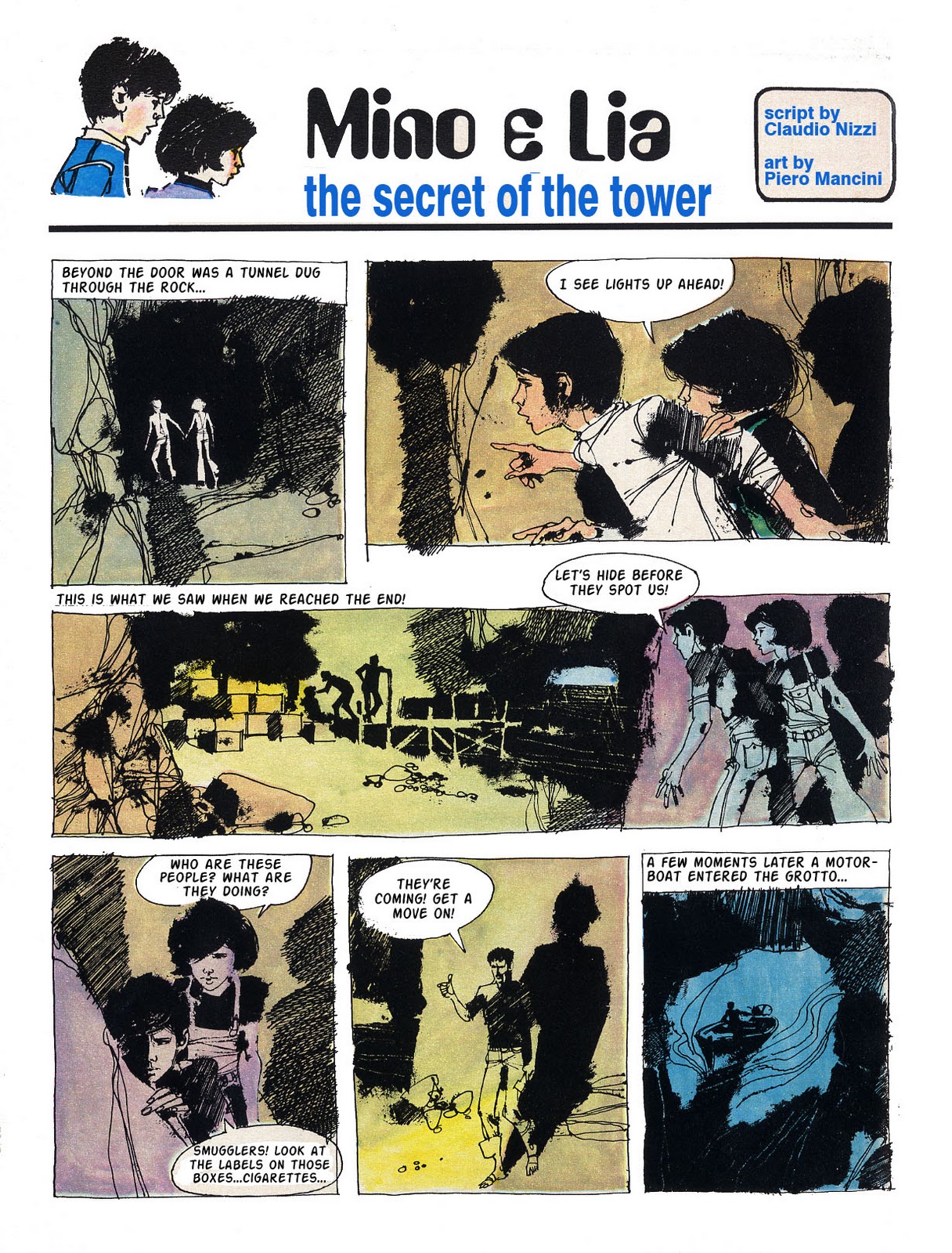
Up until the mid-1960s Mancini created numerous illustrations for a series of literary adaptations. Among the most noteworthy were a dozen plates illustrating The Divine Comedy. In 1966 Mancini started drawing comics for the Messaggero, beginning with a story about Giotto. During the next decade he provided artwork for many comics features. His best-known work was on the series Mino e Lia, written by Claudio Nizzi. Mino and Lia were ordinary modern kids who stumbled into various adventures. The series ran from 1972 to 1975.
Collection of Mino & Lia from Mera-Fumetti

In 1977 Piero Mancini illustrated an adaptation of The Diary of Anne Frank which appeared in Sgt Kirk. It was his last major project, for the artist passed away in 1979 at the age of 51.

Mancini's impressionistic style bears a certain resemblance to the work of Dino Battaglia. He went even further than Battaglia in experimenting with unusual textures. His toolkit included pen, brush, sponges, razor blades, and toothbrush splatter. The result was a very personal and attractive style which admittedly sometimes sacrificed detail for effect.

Following is one of Mancini's Mino and Lia adventures. Though only 9 pages long it was split across two issues of Il Messaggero. In fact I think it was originally intended to run in three parts. In the Italian original the last panel on page 3 seemed to set up a cliffhanger and the first row of panels on page 4 look like they were extended upward to cover a gap left for the series logo.

It's a very simple, very low-key story. A hallmark of the series was the way Mino and Lia spoke directly to the reader. Personally I find the schtick annoying, though it does help hurry the story along. To my eyes the coloring is also reminiscent of Battaglia. I have no idea whether Mancini did it himself.

All in all this is a nice job by a lesser-known star in the Italian comic universe.


English version by Ron Harris

Wednesday, January 11, 2012

Character Design--Spanish Women

The Mystery of the Spanish Woman

 
In this post I don't tell you, I ask you to tell me.


I am fascinated by the iconic Beautiful Female Face drawn by Spanish comic artists. I hope someone out there can tell me where it came from.

I first encountered the Face in the work of cartoonists employed by the Selecciones Ilustradas studio of the late 60s. These young men revolutionized comics with their work both for Spanish publications and for clients in England, France, Germany, and the USA. Among them were Esteban Maroto, Carlos Gimenez, Victor de la Fuente, Jose Ortiz, Jose Gonzales, Luis Bermejo, Rafael Auraleon, Enric Sio, etc. etc. etc. American fans first met many of them in the pages Jim Warren's horror comics, Creepy, Eerie and Vampirella.


Though their individual styles varied greatly, all these guys drew variations of the same Beautiful Female Face.
 

Rafael Auraleon, Jose Gonzales, Adolfo Usero, Jose Ortiz

At first I thought the Face was the product of the studio environment. This often happens when many artists work in the same room, especially if they're young and enthusiastic: they pick up bits of each other's style. Perhaps one of the SI men drew the Face and everybody else liked it and copied it. Or maybe an editor (or studio manager, art director, client) liked the Face and insisted everyone draw it.

Jesus Redondo, Homero


Later, though, I ran across the Face drawn by Spanish artists not connected with SI. It seemed that almost every Spanish comic artist with a "modern" (i.e. post-fifties) style used the Face. 

I associate the Face with the mid-to-late 1960s. I wish I knew more about Spanish comics from this period. Browsing Joan Navarro's excellent gallery of classic Spanish comic art I discovered artwork from late 1950s-early 1960s romance comics in which the women almost had the Face...with differences in hair style and makeup, of course.


 Purita Campos
Did the Face originate in Spanish romance comics? Was there a particular artist who created it and inspired an generation of younger cartoonists? Why is the Face particularly Spanish? A few Italian, British, and Mexican cartoonists used it, but they seemed to do so in imitation of the Spaniards.
 Frank Langford (UK)

Does anyone know the origin of this classic Spanish beauty?

Tuesday, January 3, 2012

Stuff I've Done--9


My Favorite Star Trek Page
I remember the years when I was drawing Dallas and Star Trek as a blur of lots of work, lots of frustration, lots of drama, and not much money.

I was originally hired to draw Dallas, but when Thomas Warkentin left Star Trek, that was the strip I really wanted to draw. Not only did I like the property better, but also Paramount pretty much left the strip alone. There was none of the nasty, iron-fisted editorial intervention that Lorimar practiced on Dallas. That was partly why I offered to take the strip on. Another piece was that I'd be earning more money. But the major reason was to provide an entry into the syndicate for a "good friend." This laid the groundwork for much of the aforementioned drama. Suffice it to say that one should keep personal and professional relationships separated. Widely separated.

My final Trek storyline concerned the Enterprise entering a regatta and running afoul of space pirates. It was my favorite story of the bunch. It followed a long, incredibly-complicated nightmare on which the writer collaborated with noted s-f author Larry Niven. That episode is a story in itself. I suppose I'll tell my side of it one day. I mostly remember the story as Advanced Lettering 101. There was lots of this:In comparison the regatta story was just the right length, focused, and well-plotted. The dialogue was good and there were nice character bits. It was a joy to work on, though I didn't stay through to the end. Thomas ghosted the last two weeks after I resigned both strips in a state of exhaustion.

I was always playing catch-up on Trek. The syndicate cared more about Dallas, which made a lot more money even after losing half its original list of papers. But one weekend I stayed up extra-late to do this Sunday. It remains my favorite bit of Trek art. It was one of the few originals I kept. The others I sold cheap in a fit of depression to some art dealers pretending to be fans.

The writer and I snickered over the suggestion in panel 3 (Kirk putting on his shoes) that Kirk had slept with Vera DiMarco. It was as close to sex as anyone got at the L.A. Times Syndicate. I luxuriated in doing the Wood inking thing and devoted loving attention to Vera's clingy gown. Here's a scan of the b&w proof sheet: The color version above is from the Houston Chronicle, one of the few papers that carried the strip.